Eight Brands, One Lot: What Chromatograms Reveal About Peptide White-Labelling
We fingerprinted the embedded instrument traces in every archived certificate we can open — 6,828 documents. Twenty-three times, certificates from different brands carried byte-identical chromatograms: same compound, same purity, same lot number under a different prefix.
A reader sent us a message with a simple observation: two certificates from two different brands looked like the same document. They wanted to know whether they were imagining it.
They were not.
At a glance
| Documents compared | 6,828 |
| Shared lots found | 23 |
| Brands involved | 8 |
| Laboratories | 3 — Horizon Analytical (16), Freedom Diagnostics (6), Vanguard Laboratory (1) |
| Candidate groups rejected | 11 of 34, for failing a purity check |
The two brands the reader named, Blank and Bluum Peptides, share three lots in what follows. Their pairing turned out to be one instance of a much wider pattern.
What we compared
Our certificate ledger holds 7,636 records, but not all of them are files we can open. 457 are source-only entries, where the certificate lives somewhere we can reference but not store. 101 are documents whose capture failed. That leaves 7,078 archived files, which reduce to 6,852 distinct documents once records sharing a file are counted once — and 6,828 of those contain at least one embedded image. The remaining 24 are malformed or carry no image at all.
So the comparison runs over 6,828 documents. Most of the images inside them are letterheads, signature blocks and borders. Some are chromatograms: the plot an instrument produces when it separates a sample into its components.
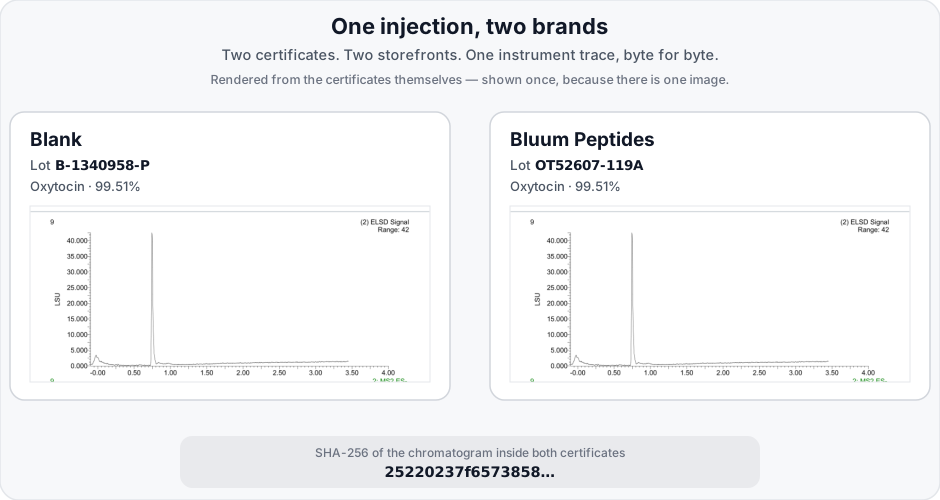
A chromatogram is not a template. It is a record of one injection, on one machine, at one moment. Two reports carrying the same chromatogram were not produced by two analyses that happened to agree — they were produced by one analysis, reported twice.
So we took the cryptographic fingerprint of every image in every certificate and looked for exact matches across brands. Byte-identical, not visually similar.
Here is what that looks like when it hits.
The filter that matters more than the finding
The first pass produced clusters that looked dramatic and meant nothing.
Laboratories reuse graphics. A letterhead, a rule beneath a heading, a signature — these recur across every report a laboratory issues, so they collide constantly. One early cluster tied twenty-eight documents together and turned out to be a border.
Two rules separate a trace from furniture:
- One compound. A real chromatogram appears under exactly one substance, because it is a picture of that substance.
- Few documents. It appears in a handful of certificates, not hundreds.
Template graphics fail both. But the check that did the most work is the third:
- Purity must agree. If two certificates genuinely share an injection, they must report the same number. Where the stated purities differ, whatever those documents have in common is not a trace.
That third check removed eleven of thirty-four candidate groups — nearly a third of what survived the first two filters. We report the twenty-three that passed all three, and we mention the eleven because a finding you cannot falsify is not worth publishing, and because it would have been easy to quietly keep them.
What the lot numbers say
The traces alone would be suggestive. The lot numbers make it plain.
Signature one: the same lot under different prefixes
| Compound | Purity | Brands | Lot numbers |
|---|---|---|---|
| AOD-9604 | 99.65% | Apex Peptides, Blank, Northline Labs | APX-3713888-P / NLL-3713888 |
| GLOW | 99.45% | Apex Peptides, Northline Labs | APX-9377026-P / NLL-9377026 |
| PT-141 | 99.25% | Apex Peptides, Northline Labs | APX-2061592-P / NLL-2061592 |
| Sermorelin | 99.21% | ezPeps, Northline Labs | 26-A1-5SR / NLL-9912173 |
| Tesamorelin | 99.19% | ezPeps, Northline Labs | 26-A4-10TE / NLL-7980975 |
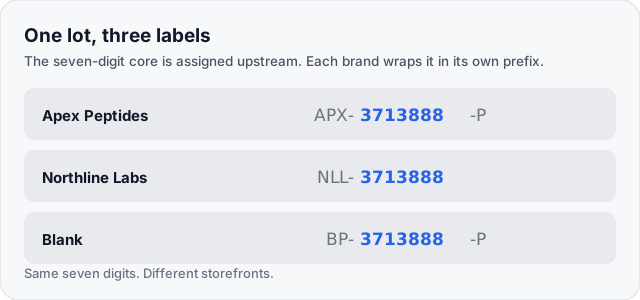
Read the first row again. APX-3713888-P and NLL-3713888 are the same seven digits with each brand’s initials attached. One upstream source numbered that lot; each brand prefixed it and printed it.
Signature two: the same lot code, unmodified
Apex Peptides and Simple Peptide publish certificates carrying the identical lot string on five separate products:
| Compound | Purity | Lot code on both |
|---|---|---|
| MOTS-C (40mg) | 99.36% | MOT40-042026-4 |
| MOTS-C (10mg) | 99.57% | MOTS10-042026-2 |
| Cagrilintide | 99.74% | CAG-042026-7 |
| GHK-Cu (100mg) | 99.86% | GHK100-052026-4 |
| Tesamorelin | 99.87% | TESM-052026-4 |
No prefix, no relabelling. The same string on two storefronts.
The full map
Twenty-three lots across eight brands.
| Brands | Lots |
|---|---|
| Apex Peptides ↔ Northline Labs | 5 |
| Apex Peptides ↔ Simple Peptide | 5 |
| Apex Peptides ↔ Blank | 3 |
| Blank ↔ Bluum Peptides | 3 |
| Blank ↔ Northline Labs | 2 |
| Northline Labs ↔ ezPeps | 2 |
| Apex Peptides ↔ Bluum Peptides | 1 |
| Blank ↔ Simple Peptide | 1 |
| Blank ↔ ezPeps | 1 |
| Bluum Peptides ↔ Northline Labs | 1 |
| Mile High Compounds ↔ Orbitrex Peptides | 1 |
One lot appears under three brands rather than two: the AOD-9604 above, carried by Apex Peptides, Blank and Northline Labs at an identical 99.65%.
The compounds are the familiar ones — AOD-9604, BPC-157, MOTS-C, PT-141, GHK-Cu, KPV, Retatrutide, Tirzepatide, Oxytocin, Semax, Selank, Sermorelin, Tesamorelin, Cagrilintide, GLOW and Tesofensine.
A twenty-fourth lot, held by a laboratory
This one belongs in its own section, because the evidence is a different kind.
Every group above is checkable by following our archive: both certificates are documents the brands published. The reader’s original message pointed at a certificate that is not in our archive — and the reason is worth stating plainly.
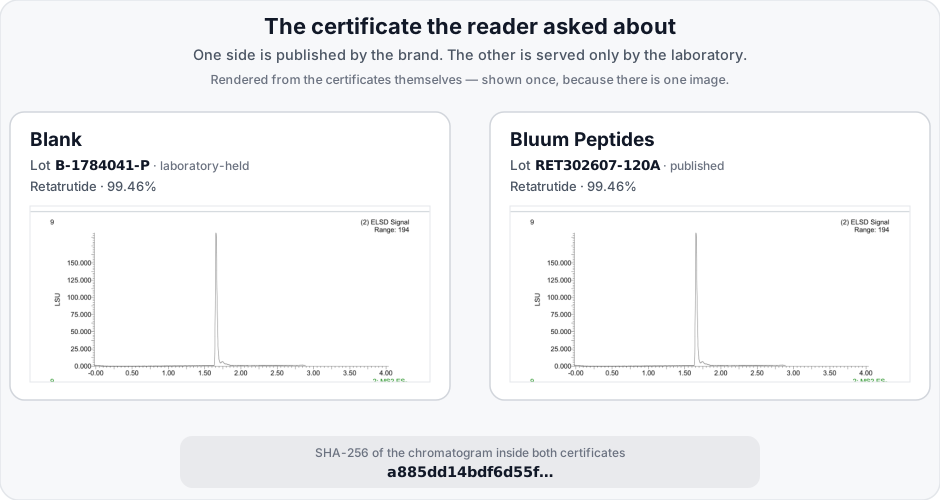
B-1784041-P is a Blank-client Retatrutide report. Horizon Analytical serves it publicly. Blank does not link it from any product page, so it never entered our archive, which is built from what vendors publish. Retrieved from the laboratory directly, it shares three distinct embedded traces with Bluum Peptides’ RET302607-120A — both Retatrutide, both 99.46%.
So the reader’s specific example was correct, and we could only confirm it by going to the laboratory rather than the vendor.
This is not a claim of concealment. There is nothing improper about a certificate that hasn’t been added to a product page, and the dullest explanation — nobody got round to it — is at least as likely as any other. We separate it here because it rests on a different evidentiary footing, not because it reflects worse on anyone. It also marks the honest limit of this method: an archive built from what brands publish cannot see a lot where neither brand chose to publish.
How a lot ends up under two names
Worth stating plainly, because the pattern invites a more dramatic reading than it deserves: there is a mundane mechanism behind it, and one of the brands named above has described it publicly.
In an April 2026 exchange on X, Blank said that it operates a wholesale side supplying clinics and companies, that it works with contract manufacturers rather than synthesising in-house, and — directly to the point here — that “all of our previous COAs were produced under the names of our wholesale customers.”
That is this finding’s mechanism, described by a participant before we went looking for it. A wholesaler supplies several brands from one lot; the laboratory issues a report per customer; the same analysis ends up on several certificates. Our trace comparison detects the result of that arrangement. It does not detect anything anyone was hiding.
It also means the direction of supply is not something this method can resolve. A byte-identical trace proves two brands sold from one lot. It cannot tell you which of them bought from the other, or whether both bought from a third party none of them names. Where you see two brands in the tables above, do not assume one is downstream of the other.
It is not just the same powder
There is a natural objection to everything above, and it is a fair one: raw material is not finished product. Two kitchens can be sent the same chicken and serve different meals. If these brands buy the same powder and each fills, finishes and handles it their own way, the shared certificate would say very little about what arrives at your door.
The certificates answer that objection themselves.
43 of the 48 certificates in these shared lots report net content — a labelled quantity against a measured one. Eighteen report endotoxin. Neither test is possible on bulk powder: there is no label to measure against and nothing yet to be sterile. Those are measurements of a filled, labelled vial.
And where two brands both state a fill, the fill is identical:
| Compound | Brands | Labelled | Measured |
|---|---|---|---|
| AOD-9604 | Northline Labs, Blank | 5 mg | 4.75 mg |
| BPC-157 | Simple Peptide, Blank | 500 mcg | 477 mcg |
| Selank | Blank, Northline Labs | 10 mg | 9.8 mg |
| MOTS-C | Apex Peptides, Simple Peptide | 40 mg | 40.48 mg |
| MOTS-C | Apex Peptides, Simple Peptide | 10 mg | 10.07 mg |
| Cagrilintide | Apex Peptides, Simple Peptide | 10 mg | 11.22 mg |
| GHK-Cu | Apex Peptides, Simple Peptide | 100 mg | 94.85 mg |
| Tesamorelin | Simple Peptide, Apex Peptides | 10 mg | 10.57 mg |
Read the first row. A 5 mg vial containing 4.75 mg — a 5% shortfall — reported on Northline’s certificate and on Blank’s. One vial was weighed. Two brands published the number.
So whatever separates these brands, it happened either before the vial was filled or after it was tested. It did not happen in between, because the filling and the weighing were done once.
That does not make any brand’s handling irrelevant. Storage, shipping and how long a vial sits somewhere warm are real, and no certificate captures them. But the differentiation buyers are usually told about — better sourcing, better filling, tighter process control — is upstream of these documents, and these documents cannot evidence it.
What this does and does not establish
It establishes that these brands sold from common lots, and — for most of these certificates — from the same filled lot, with one analysis reported per brand.
It does not establish shared ownership. Two unrelated storefronts buying from the same contract manufacturer produce exactly this pattern, and that is the most ordinary explanation available. Nothing here suggests a forged certificate or a misstated result — every certificate in this analysis verifies at the laboratory that issued it. The laboratories behaved correctly throughout: they tested the material they were sent and reported to whoever commissioned the work.
White-labelling is not a scandal either. Very few peptide storefronts synthesise anything, none of these claims to, and buying finished material from a manufacturer is how most of this market works.
What it undercuts is a specific inference buyers make. If you order the same compound from two brands to hedge against one supplier’s quality control, and both certificates trace to one injection of one lot, you have bought from the same batch twice at two prices — in eight of these lots, demonstrably the same filled vial, measured once. On these twenty-three lots, that is what happened.
Diversifying across brands is not the same as diversifying across sources — and until the certificates are laid side by side, a buyer has no way to tell.
A note on our own numbers
While checking this, we found a flaw of our own. Three certificates were indexed at 98% purity where the documents plainly state 99.45%, 99.31% and 99.36% — the ≥98% specification threshold recorded instead of the measured result.
The cause turned out duller than a broken reader, and worth stating precisely: our reader already handles that layout correctly. Those three values were stored before it learned to, and nothing had re-read them since. Stale numbers, not a live defect. They have been re-extracted, and no certificate in the archive still carries a specification threshold in place of a result.
It changed no conclusion — every purity here was verified against the certificate text rather than trusted from our index, which is also how we caught it. It did, however, add a finding: the GLOW pair above only qualifies once Northline’s certificate reads its true 99.45% instead of our mistaken 98%, because a purity that disagrees is exactly what the third filter rejects. Our own error had been suppressing a real result.
We mention it because a benchmark that only publishes other people’s errors is not worth much.
Method
Every archived certificate is fetched, its embedded images are fingerprinted with SHA-256, and matches are grouped across vendors. A group is reported only when the shared image appears under a single compound, in six documents or fewer, across two or more brands, with no disagreement in stated purity. Every purity was then re-read from the certificate text rather than trusted from our own index.
Two details in the interest of precision. The purity filter rejects disagreement; where neither certificate states a purity, there is nothing to disagree and the group stands on its trace and compound alone — two of the twenty-three are in that position. And purity alone is a poor signal, which is why we never use it on its own: at two decimal places, unrelated products collide by coincidence often enough to bury anything real. An identical instrument trace does not collide by coincidence.
This is a standing check rather than a one-off study: the comparison runs whenever the archive updates, so newly published certificates are checked against everything already held.
Disclosure
Three of the eight brands named above are PeptideBenchmark affiliate partners, and we earn a commission when a reader buys through our links to them:
- Apex Peptides — code
benchmark, 10% off. It appears in thirteen of the twenty-three lots, more than any other brand. - Mile High Compounds and Orbitrex Peptides — the two brands in the single Vanguard-certified lot.
Blank, Bluum Peptides, Northline Labs, Simple Peptide and ezPeps have no affiliate relationship with us.
We are stating this prominently rather than in a footnote because the brand most implicated by this analysis is one we are paid to refer. The grouping was produced from certificate contents alone, before any commercial relationship was consulted, and no vendor was given advance sight of it. Readers should weigh the disclosure for themselves — but a finding that is inconvenient for our own partners is, if anything, the kind we should be most willing to publish.
Common questions
Does a shared lot mean these brands are the same company?
No, and we want to be precise about that. Shared lots show a common upstream source and per-brand certificate issuance. They do not establish shared ownership, shared management, or any relationship between the brands beyond a supplier they may each have sourced from independently. Two unrelated storefronts buying from the same manufacturer would produce exactly this pattern.
Is white-labelling a sign that a vendor is dishonest?
No. Buying finished material from a contract manufacturer and selling it under your own brand is ordinary and lawful across many industries, and none of the brands named here claims to synthesise its own peptides. Nothing in this analysis suggests any certificate was forged or any result misstated. What it changes is what a buyer can infer from purchasing two brands rather than one.
How can two certificates share a chromatogram?
A chromatogram is a picture of one injection on one instrument. When two certificates embed the same image file, byte for byte, the underlying analysis was run once and the report was issued more than once. That is expected when a laboratory tests a lot and the material is later distributed under several brand names.
Which laboratories issued these certificates?
Horizon Analytical certified sixteen of the twenty-three lots, Freedom Diagnostics six, and Vanguard Laboratory one. All operate public verification pages and the certificates in this analysis check out on them. The laboratories are not the subject of the finding — they tested the material in front of them and issued reports to whoever commissioned the work.
Could the brands have bought the same raw powder and finished it differently?
Not on most of these certificates. 43 of the 48 report net content — a labelled quantity measured against an actual one — and 18 report endotoxin. Neither test is possible on bulk powder, because there is no label to measure against and nothing yet to be sterile. Those are measurements of a filled, labelled vial. In eight lots two brands state an identical labelled-and-measured pair, meaning one vial was weighed and both brands published the result. Storage and handling still differ and no certificate captures those, but filling is not where these brands diverged.
Does a shared lot mean one brand is reselling another's product?
Not necessarily, and this method cannot tell you. A byte-identical trace proves two brands sold from one lot; it cannot establish which bought from the other, or whether both bought from a third party. Blank has publicly described operating a wholesale side whose certificates were issued under its customers' brand names, which is one ordinary arrangement that produces exactly this pattern.
How do you tell a real chromatogram from a laboratory letterhead?
Three filters. A chromatogram depicts one compound, so an image appearing under several compounds is not one. It appears in a handful of documents, not hundreds. And two certificates sharing an injection must report the same purity — when the stated purities differ, whatever those documents share is template graphics. That third check removed eleven of thirty-four candidate groups.