When 'Research Use Only' Meets the Owner's Own Posts
A peptide vendor's site says 'research use only — not for human or animal consumption.' Its owner's public posts discuss human weight-loss dosing, two years of human use, and therapeutic 'healing.' We lay the two side by side against the FDA's intended-use standard and let you judge.
Almost every gray-market peptide site carries the same disclaimer: research use only, not for human consumption. It is the sentence that is supposed to keep an unapproved compound on the right side of the line.
The problem is that a disclaimer is not magic words. Under the standard the FDA actually uses, what a product is for is decided by what the seller says and does — not by a line in the footer. So when a vendor’s public marketing points one way and its disclaimer points the other, it is worth putting the two side by side.
Here is a clean, self-documented example. Everything below is either published on the vendor’s own website or posted publicly by the vendor’s owner. We are not adding interpretation to the quotes — we are just placing them next to each other.
This is not a legal determination and not an accusation of unlawful conduct. It is a factual comparison of a company’s own public statements against a publicly available regulatory standard. Readers can draw their own conclusions.
What the website says
Wolverine Peptides presents itself, in its own words, around “RUO positioning,” “batch transparency,” and a “quality-driven research supply.” Its Research Use Only disclaimer is explicit:
“All products provided by Wolverine Peptides are intended strictly for laboratory, research, or analytical purposes only. These materials are not for human or animal consumption, nor for therapeutic, diagnostic, or clinical use. Wolverine Peptides is a research compound supplier, not a compounding pharmacy or medical provider. Products are not intended to diagnose, treat, cure, or prevent any disease or medical condition.”
That is about as strong a research-use statement as these disclaimers get.
What the owner posts
The same brand’s owner, who posts publicly as @WolverineDavis, uses his account to discuss the products in terms of human use, human dosing, and health outcomes. A sample, in his own words:
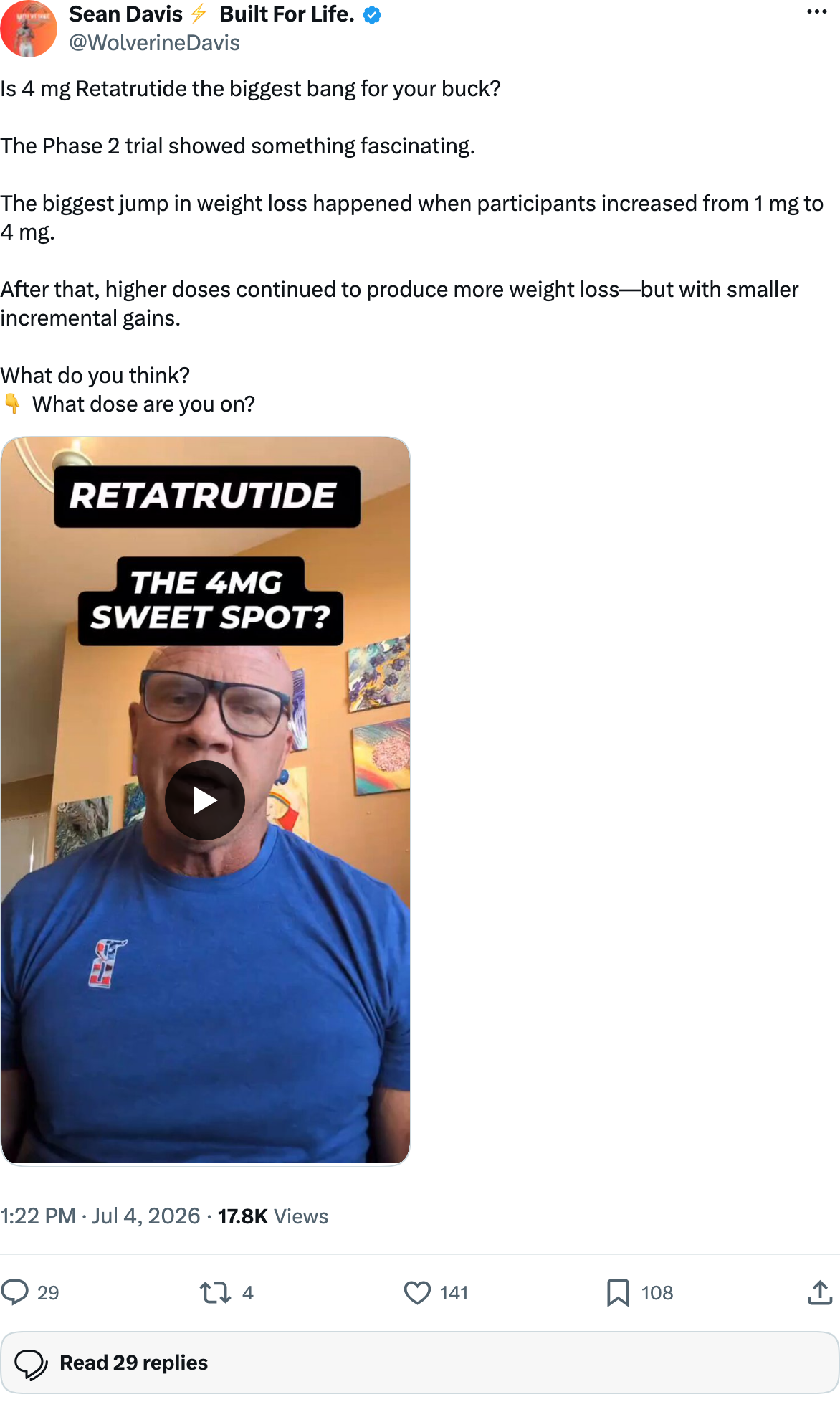
On human weight-loss dosing of retatrutide — an investigational compound still in clinical trials, not approved by the FDA for anything (July 2026):
“Is 4 mg Retatrutide the biggest bang for your buck? The Phase 2 trial showed something fascinating. The biggest jump in weight loss happened when participants increased from 1 mg to 4 mg… 👇 What dose are you on?”
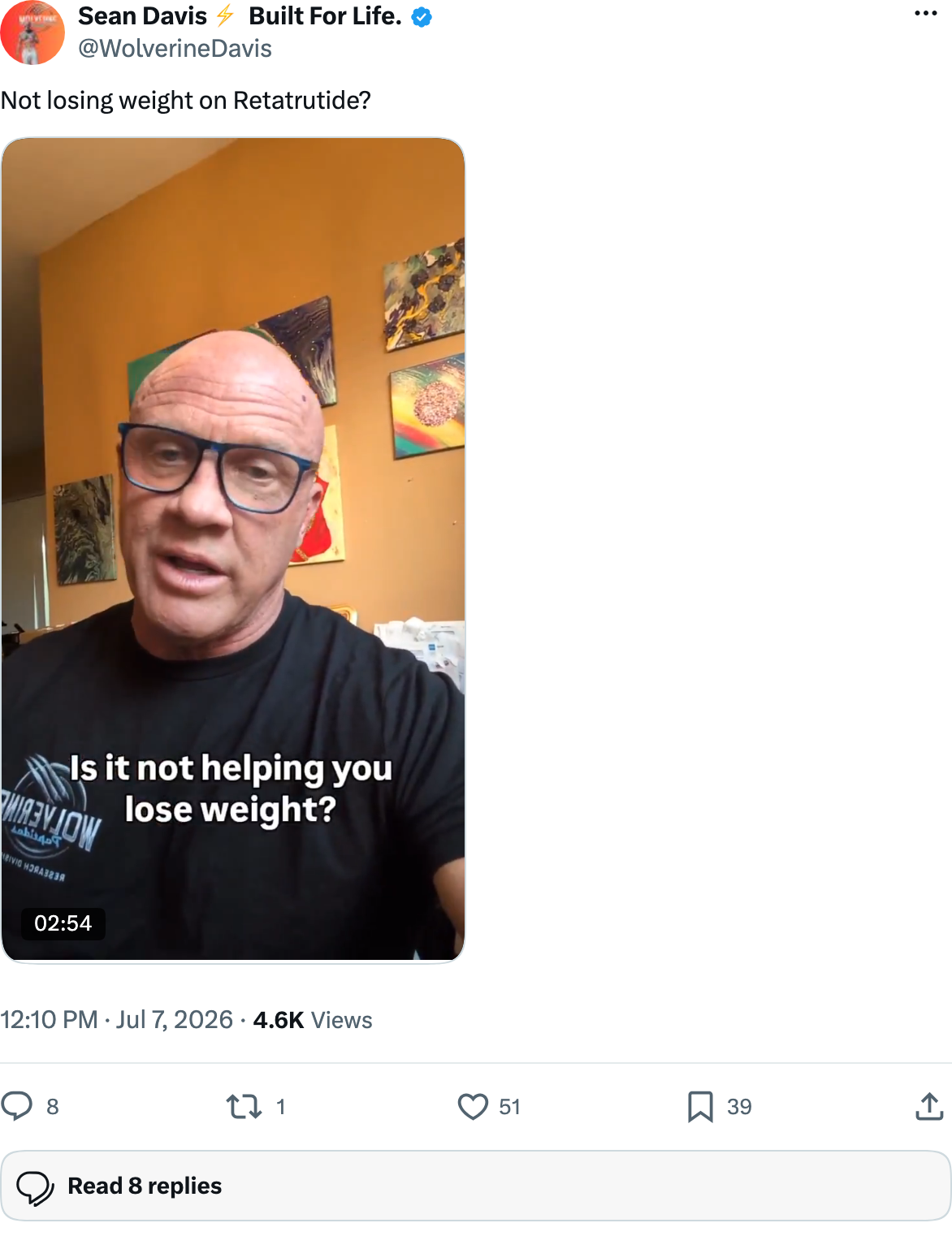
A separate post attaches a video captioned “Not losing weight on retatrutide?”
On dosing another unapproved compound — ATX304 / O-304, an experimental AMPK activator (July 15, 2026):
“ATX304 (O-304) will become the biggest thing since retatrutide… 🔥 Burn more energy 💪 Preserve muscle ❤️ Restore metabolic health ⚡ Increase work capacity… And the doses that will be most effective aren’t going to be 50 mgs a day. 400 mgs–1 gram a day is my guess.”
A day later, he posted that he is taking it himself (July 2026):
“So I am currently taking ATX 304 (O-304) for about 3 weeks… I am taking 400 milligrams a day like they did in the recent phase 1 human trials… I’ve lost 7 pounds… And here’s the thing, I feel no stimulant whatsoever.. I actually feel nothing.”

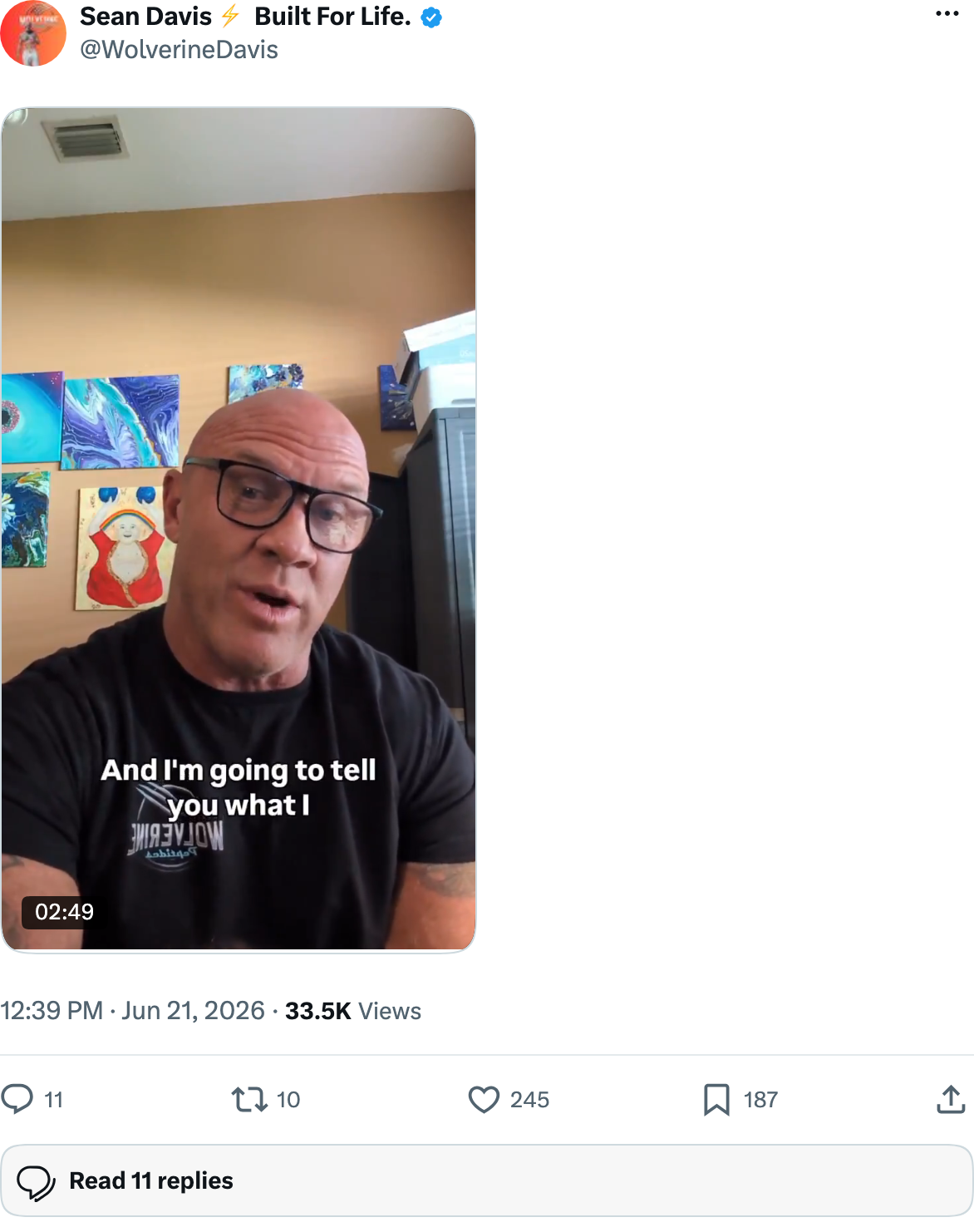
On multi-year human use — a video titled “What happens after 2 years on Reta,” under which a customer replies that she is “about 15 months now” on “Reta” and calls it “life changing,” and the owner responds (June 21, 2026):
“Heck yeah 👍 That’s so great to hear.”
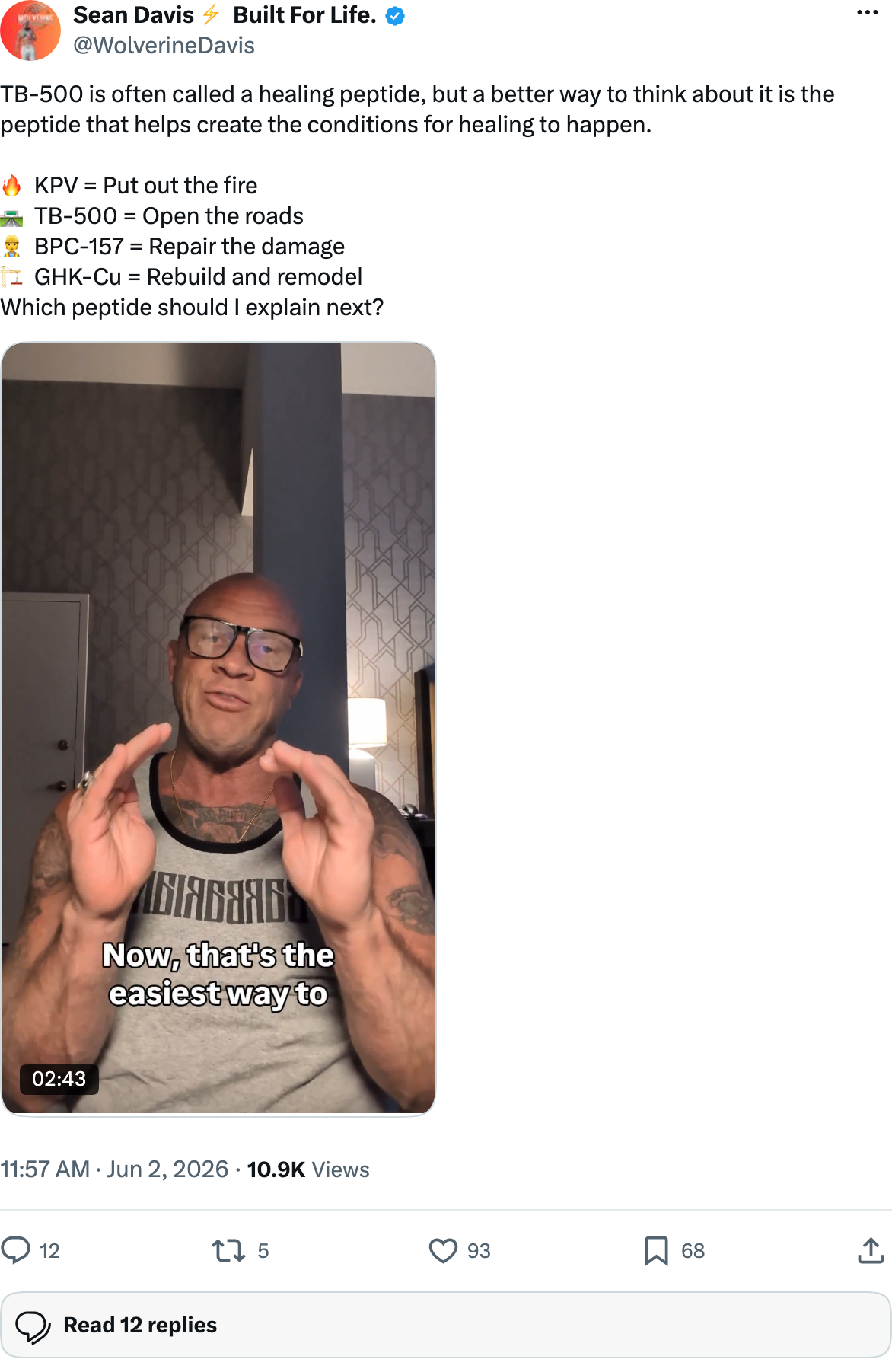
On therapeutic ‘healing’ — a framework applied across a product stack (June 2026):
“TB-500 is often called a healing peptide… 🔥 KPV = Put out the fire 🛣️ TB-500 = Open the roads 👷 BPC-157 = Repair the damage 🏗️ GHK-Cu = Rebuild and remodel.”
The standard those two things are measured against
You do not have to take our word for how this is evaluated. The framework is public.
Under the Federal Food, Drug, and Cosmetic Act, a product is a “drug” if it is intended to affect the structure or function of the body, or to diagnose, treat, cure, or prevent disease (21 U.S.C. § 321(g)). Critically, the FDA determines that intended use from the seller’s objective conduct — its labeling, advertising, and the statements of its principals — not from a disclaimer alone. The agency’s intended-use regulation (21 CFR 201.128) says intended use may be shown by “oral or written statements” by the seller or its representatives and by “the circumstances surrounding the distribution of the article.”
In plain terms: the FDA’s long-standing position is that a “research use only” label does not control when the seller’s own promotion shows the product is meant for people. The label and the promotion are read together.
The two, side by side
- The website says: not for human or animal consumption; not for therapeutic use; not intended to treat any condition.
- The owner’s posts discuss: what human dose of retatrutide gives the best weight loss; a compound he says he personally takes at 400 mg/day “like they did in the recent phase 1 human trials,” with a weight-loss result; two years of a customer’s human use; and peptides that “repair,” “rebuild,” and “heal.”
We are not going to tell you those two things are illegal — that is a determination for regulators and courts, not a peptide-comparison site. We are simply pointing out that they are hard to hold at the same time, and that the regulatory standard above is the lens through which that tension is normally read.
One smaller note, for the “batch transparency” claim: the same catalog lists a product as “O-304 (ATX304) Capsules 50mg Label (60 Count) — Current Batch Tests 41mg.” Disclosing an ~18% gap between the label and the tested content is unusually candid, but it is also a 50 mg label on a 41 mg product — which is its own accuracy question, sitting under a banner about quality and documentation.
Why this matters if you are buying
This is the whole reason we do not treat marketing language as a trust signal. “Research use only” on a label tells you nothing about what a vendor is actually doing, and a founder’s content can say the quiet part out loud while the footer says the opposite. The only things that hold up are the ones you can verify independently — third-party lab results, provider-verifiable certificates of analysis, and observed prices — which is what our vendor trust scores are built from.
Our position
We have no relationship with Wolverine Peptides — no affiliate arrangement, no partnership, nothing. We do run disclosed affiliate relationships with other vendors, listed openly on our coupon and referral page; none of that touches this post. And to repeat the line at the top: nothing here is a legal determination or an accusation of unlawful conduct. It is a documented contradiction between a company’s disclaimer and its own public promotion, measured against a public standard, with the conclusion left to you.
Public positioning and public posts can also diverge after a project changes lanes. For a separate, sourced case study on that transparency question, see the Reptides hub and the full Reptides RUO vendor history.
All quotations are from Wolverine Peptides’ public website or the public posts of @WolverineDavis, as of July 2026. Screenshots are retained on file. Research peptides are not approved for human consumption.