Reptides and the Line Between Peptide Information and Directions for Use
Reptides refuses vendor money and refuses to publish dosing guides — both good calls. It also runs an affiliate program for its own app, and the one promotional post we can document carried no in-post disclosure.
Reptides has spent July making a claim worth taking seriously: that the peptide industry needs an evidence layer, and that the people building one should not be paid by the vendors they grade.
That instinct is right, and on two of the hardest calls in this space they have landed better than most. Three things about how the platform ships sit awkwardly against that, and one of them is not the one people reach for.
PeptideBenchmark competes with Reptides. Both want to be the reference layer peptide buyers check first. PeptideBenchmark earns affiliate commissions from some vendors it covers, and offers a paid, clearly labelled "PB Pick" placement to curated vendors at $500/month — the slot is open and unsold as of publication. Both are disclosed. Reptides says it takes no vendor money, clinic deals or sponsorships at all, which on that specific axis is a stronger position than ours. Read this knowing we have a commercial interest in the comparison. Every post cited below is public, dated, linked and screenshotted, so the record survives an edit or a deletion.
What they are getting right
Peptide information is overwhelmingly published by people who sell peptides, and that distortion is the whole reason an independent layer has value. Refusing vendor money removes the most obvious failure mode by construction, and Reptides states that refusal plainly.
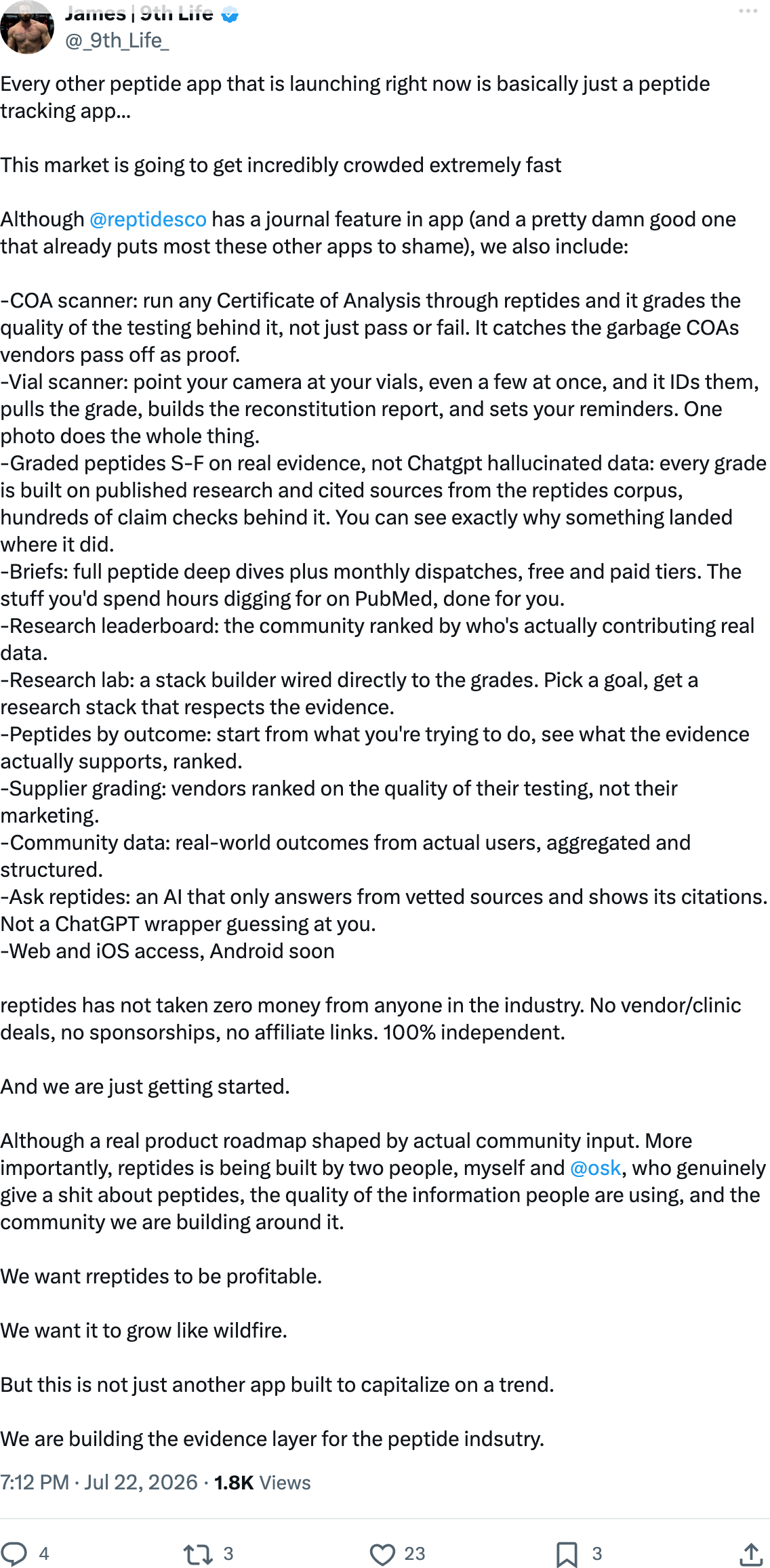
They have also drawn the harder line, the one most of this industry ducks. On May 13 the account behind the project said Reptides does not sell dosing guides for retatrutide or other peptides not FDA-approved for the uses people discuss online, and gave the reason: publishing that guidance could be read as unauthorized practice of medicine. That is a more careful piece of reasoning than the category norm, and it is documented in our earlier timeline.
Their published caveats have been better than the norm too. When they released a community readout on retatrutide, they said in the same post that 31 self-reported responses from a self-selected group is not a trial, reported the adverse effects alongside the favourable ones, and noted that 29 of 31 respondents were male.
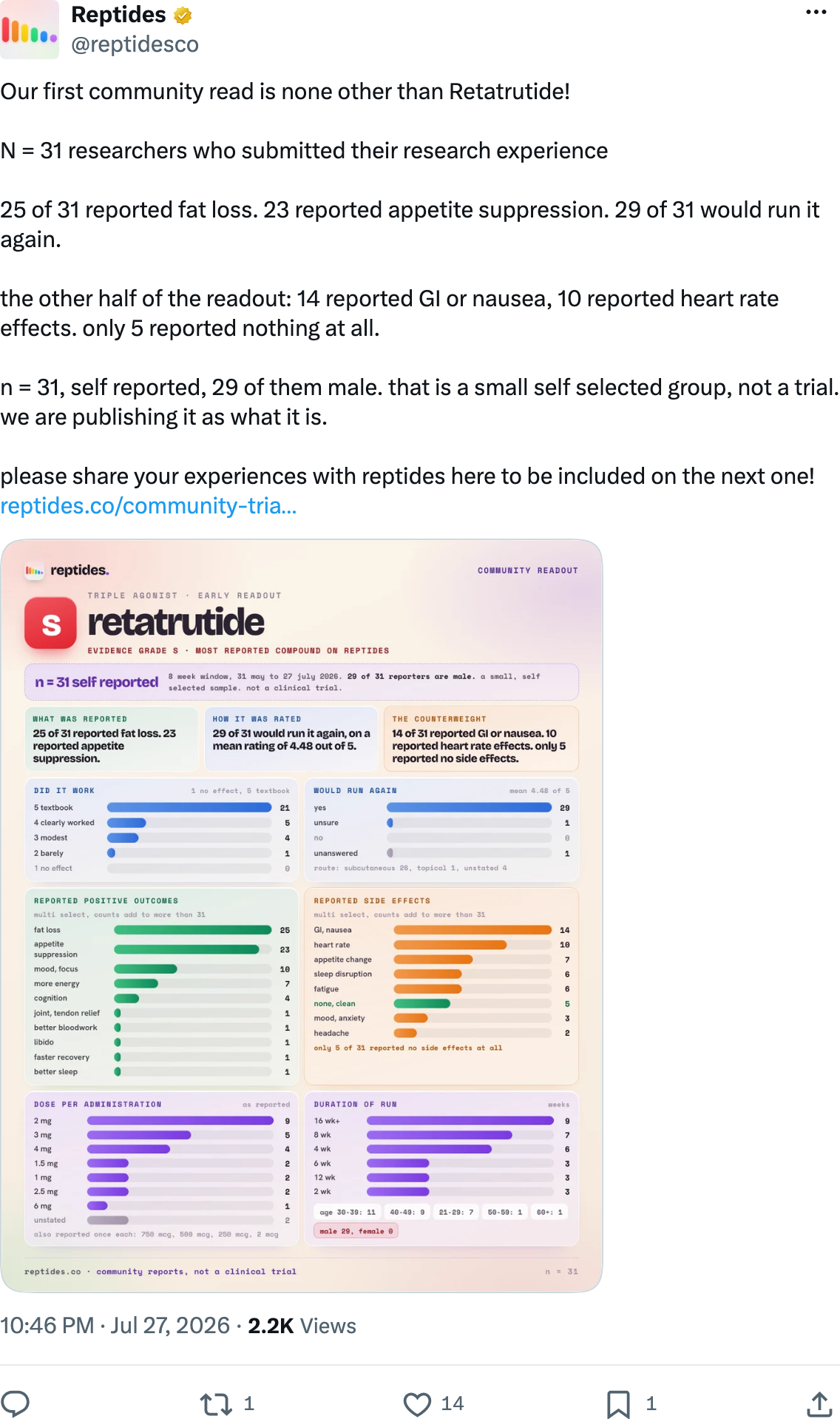
A lot of outlets would have turned 29 of 31 into a 94% headline and buried the denominator. That is the standard the rest of this article measures against.
1. The affiliate program, and where a disclosure has to sit
Reptides runs an affiliate program for its own app subscriptions. One promoter, Teddy (@999TeddyB), carries a referral link and a named discount code in his X bio:
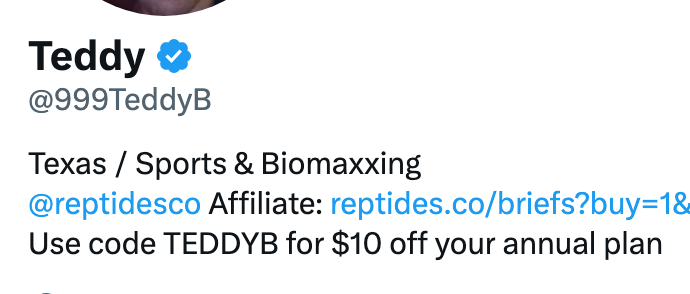
None of that conflicts with the independence claim. Taking no money from vendors and paying people to promote your app are different transactions, and a platform can honestly do the second while refusing the first. But it means “100% independent” is doing narrower work than a casual reader will assume, and it means some of the visible enthusiasm around the product is incentivised.
Which brings the obligation. On July 30, Reptides quote-tweeted praise from that same promoter — the post mentions working out a starting dose for KPV — and added a product-roadmap note:
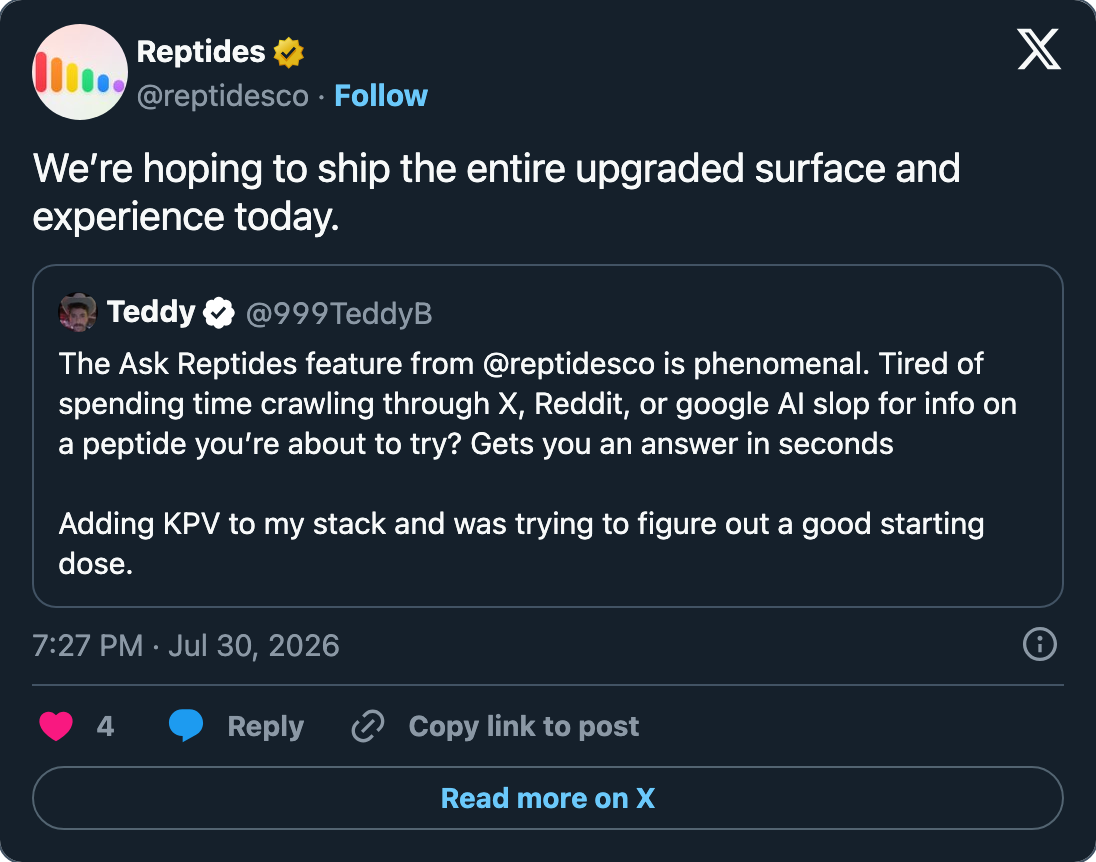
The FTC Endorsement Guides require a material connection to be disclosed clearly and conspicuously — since the 2023 revision, unavoidable, in the endorsement itself rather than a bio a reader has to go and find. An affiliate arrangement of this shape normally pays a commission, though we have not seen the terms. The endorsement carries no disclosure.
To be clear about what this is and is not. Teddy discloses the relationship in his bio, publicly and unambiguously — this is a placement problem, not concealment, and it is the single most common compliance miss in the category. The obligation the FTC puts on the advertiser is the sharper one: the Guides expect a program that trains and monitors endorsers, and quote-tweeting an undisclosed endorsement is the opposite of monitoring. The fix is one line in the post.
We can document one such amplified post. We are not claiming a pattern.
2. Founder posts are a separate rule
Reptides is built by two people, one of whom posts about the product publicly. Some of those posts are written in the register of a satisfied user — a July 13 post walks through “how I used” the app that day.
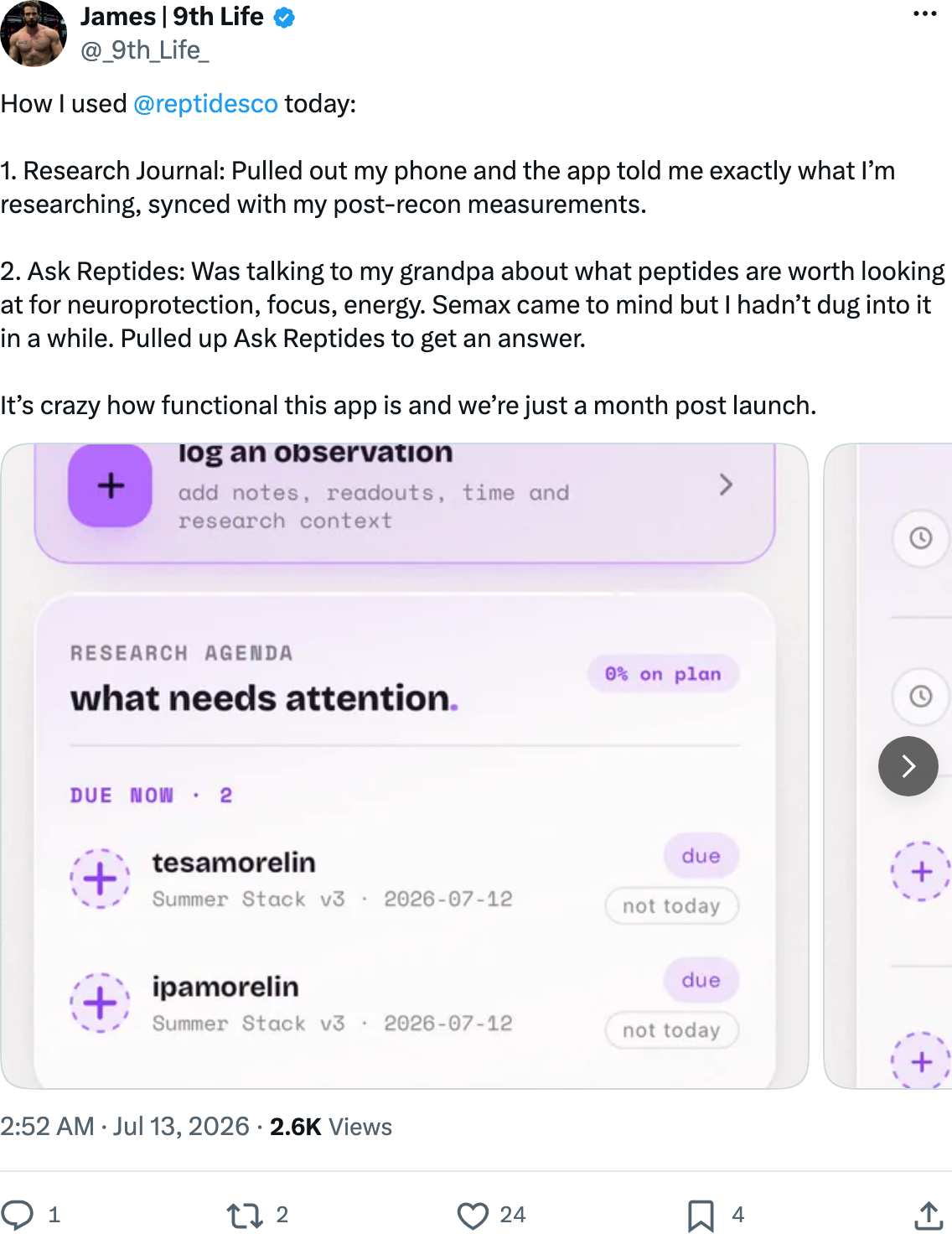
In fairness, that post closes with “we’re just a month post launch” — an insider signal in the post itself — and the same account states elsewhere that he is one of Reptides’ two builders. The connection is visible to anyone reading the feed.
The question the Rule on Consumer Reviews and Testimonials asks is narrower than “could a reader work it out”: it addresses testimonials by officers, managers, employees and agents, and unlike the Endorsement Guides it carries civil penalties. Whether a stray “we” counts as clear and conspicuous disclosure of an officer relationship is exactly the sort of thing the rule was written to remove ambiguity from. A labelled line costs nothing.
3. The FDA question is real, but narrower than people assume
The usual argument runs: peptides are unapproved drugs, the app tells people how to use them, therefore FDA problem. That argument mostly does not work against a publisher, and reaching for it makes the genuine issues easier to dismiss.
FDA’s authority runs through distribution. Unapproved-new-drug and misbranding provisions attach to whoever introduces the article into commerce. Intended use under 21 CFR 201.128 is established by labelling, advertising, and the circumstances surrounding the distribution of the article — which is why a “research use only” sticker fails when a seller’s own conduct shows human-use intent. That analysis binds sellers.
Reptides does not sell peptides today, which makes its current posture that of a publisher, and truthful health publishing has substantial First Amendment protection. Explaining reconstitution or storage is something magazines have done for a century.
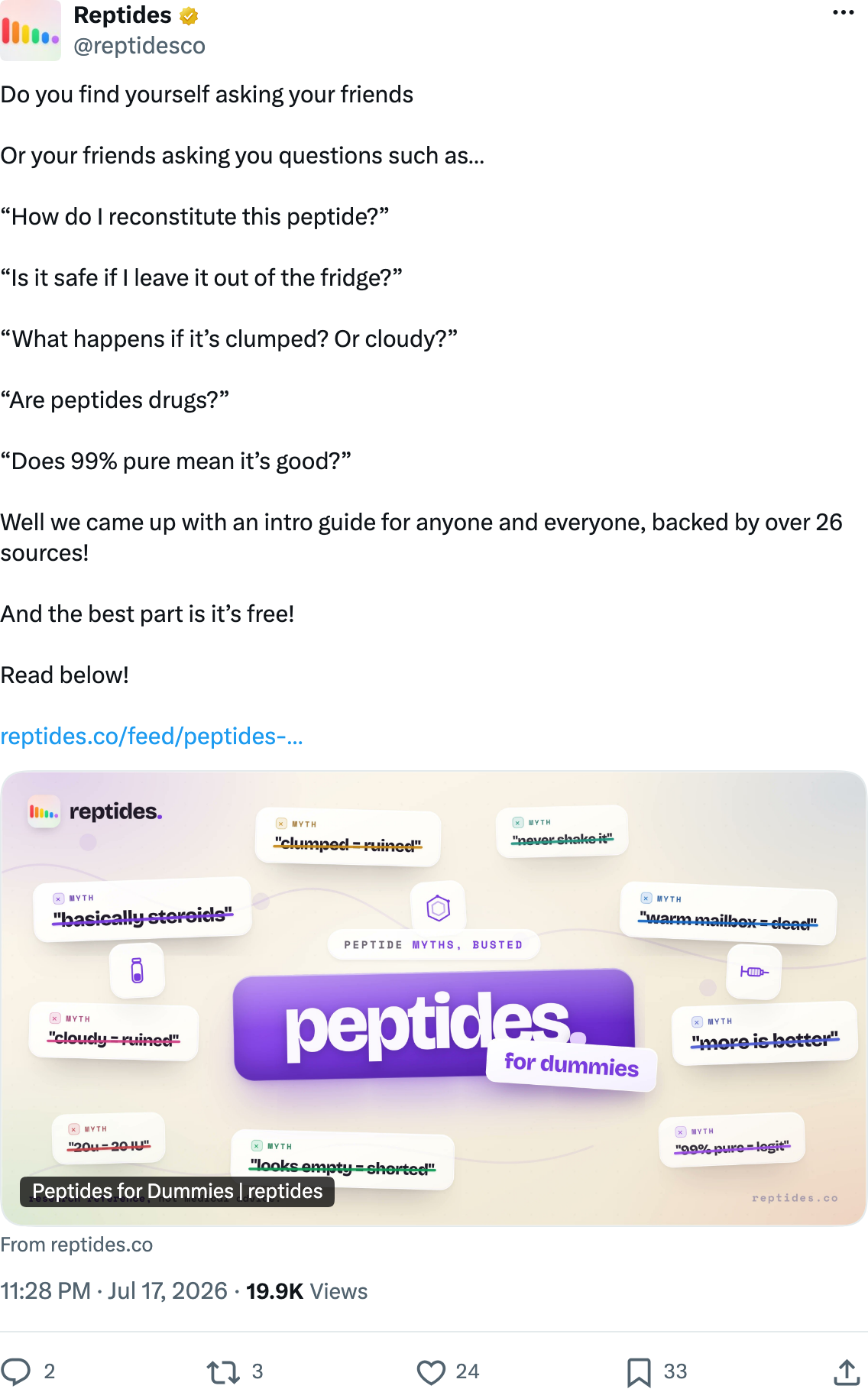
Two caveats stop that being a clean answer.
The history. Public posts from the @ogsvg account described an earlier phase with a store, product listings, buyers, and revenue as a research peptide company, and a June 26 post described work on a peptide hair serum prototype — not an RUO injectable, but not purely a publisher’s roadmap either. We documented that timeline in Reptides: RUO Vendor History and Public Record. “We don’t sell peptides” is true of the platform today; it is not true of the project’s whole history.
The direction of travel. There is a difference between here is what the literature reports about semax and a system that takes a person’s goal and returns a protocol for them. A stack builder wired to outcome grades, and an AI that users bring dosing questions to, both sit closer to that edge than a reference article does.
That said: we have not seen what Ask Reptides returns to a dosing question. The only evidence in front of us is a user saying he had one, not an answer the tool gave — and Reptides has publicly committed to not publishing dosing guidance for exactly these compounds. The concern is about where the product could drift, not a claim about what it currently outputs.
4. Grades are claims, and register is part of the record
Ranking peptides S through F on what the evidence supports, and offering “peptides by outcome,” is a claim about efficacy. The FTC’s Health Products Compliance Guidance requires competent and reliable scientific evidence for that — generally well-controlled human studies, for the specific claim as a consumer would understand it. Citing sources is necessary but not sufficient. A grade compresses a literature into one character, and compression is where substantiation gaps hide. Aggregated self-reported outcomes, however honestly captioned, are not substantiation for an efficacy claim.
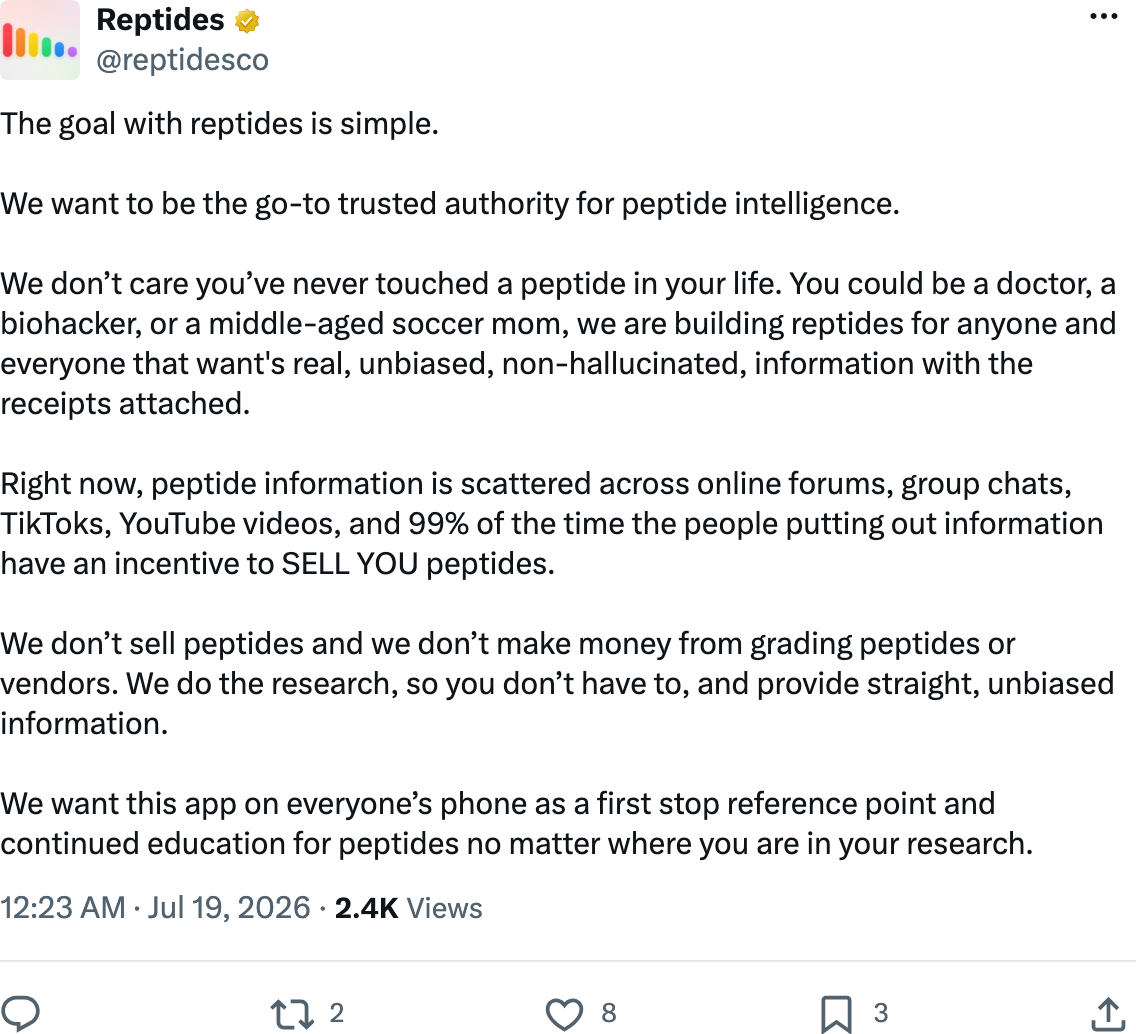
Then there is register. The same accounts that want Reptides to be “the go-to trusted authority for peptide intelligence” —
— also use “lab rat” framing, in a post promoting the app’s research journal, for what reads as personal use:

— and joked that the driver in a near-miss clip had not skipped his semax dose.

The second is a joke, and reading it humourlessly would be silly. But “lab rat” is specifically the vocabulary the research-use-only convention uses to wink at human consumption, and it appears there inside a product promotion. A platform whose thesis is that the industry’s information problem is people pretending cannot comfortably run on the pretence. Given that Reptides has already reasoned publicly about where the human-use line sits, this looks less like a position than an inconsistency worth tidying.
What this means if you are choosing a source
Nothing here says Reptides is a bad product or that its team acts in bad faith. The opposite: refusing vendor money is the right call, refusing to publish dosing guides is the harder and rarer one, and the caveats on their community data beat the industry norm.
The useful question is narrower. What is this source paid to tell me, and what does it do when the evidence runs out?
On the first, the honest answer is more textured than “100% independent”: no money from the vendors it grades, but a paid promoter network for the product itself, whose posts should say so. On the second, a letter grade is a compression, an AI answer is a summary, and a self-selected survey of thirty-one people is a signal rather than a finding.
Those limits hold regardless of who publishes, including when it is us. PeptideBenchmark takes affiliate commissions and sells a labelled sponsor placement, discloses both, publishes certificate provenance rather than efficacy grades, and recommends no doses anywhere on this site.
Readers can check our affiliate disclosures, the COA database, how the vendor benchmark works, and our earlier Reptides vendor-history timeline.
Common questions
Is Reptides breaking the law?
This article makes no such finding, and PeptideBenchmark is not a law firm. It describes what FDA and FTC rules require of peptide information platforms, and where specific public posts sit relative to those requirements. Whether any particular conduct crosses a line depends on facts that are not public, including the terms of its affiliate agreement and the actual output of its AI feature.
Does Reptides have an affiliate program?
Yes, for its own app subscriptions. We documented its June 22 announcement in our earlier Reptides timeline. That is separate from — and not contradicted by — its statement that it takes no money from peptide vendors, clinics, or sponsors. One is money flowing in from the industry it grades; the other is money flowing out to people who promote the app. Both can be true at once, but only the first is covered by '100% independent.'
Does Reptides sell peptides?
Not currently. Public posts from the @ogsvg account described an earlier phase with a store, product listings, buyers, and revenue as a research peptide company, and a later post described work on a peptide hair serum prototype. We documented that timeline separately. The current posture is a publisher; the history is more mixed, and that matters for how much weight the independence framing can carry.
Does Reptides publish dosing guidance?
It has publicly said it does not, and gave a specific reason: publishing dosing guidance for peptides not FDA-approved for the uses people discuss could be read as unauthorized practice of medicine. That is a better-reasoned line than most of this industry draws. We have not seen what its AI feature returns when a user asks a dosing question, and we do not claim to know.
Does PeptideBenchmark compete with Reptides?
Yes, and readers should weigh this article accordingly. PeptideBenchmark earns affiliate commissions from some vendors it covers and offers a paid 'PB Pick' placement to curated vendors at $500/month, both disclosed. Reptides says it takes no vendor money at all. On the narrow question of who has fewer financial ties to the vendors they grade, their stated position is stronger than ours.