From Personal Protocol to Promo Code: Inside the Real Peptides–Michael Morelli Affiliate Funnel
A documented look at how personal-use peptide protocols, scientific claims, research-use-only disclaimers, and 40–50% affiliate codes converge across Michael Morelli's posts and Real Peptides' storefront.
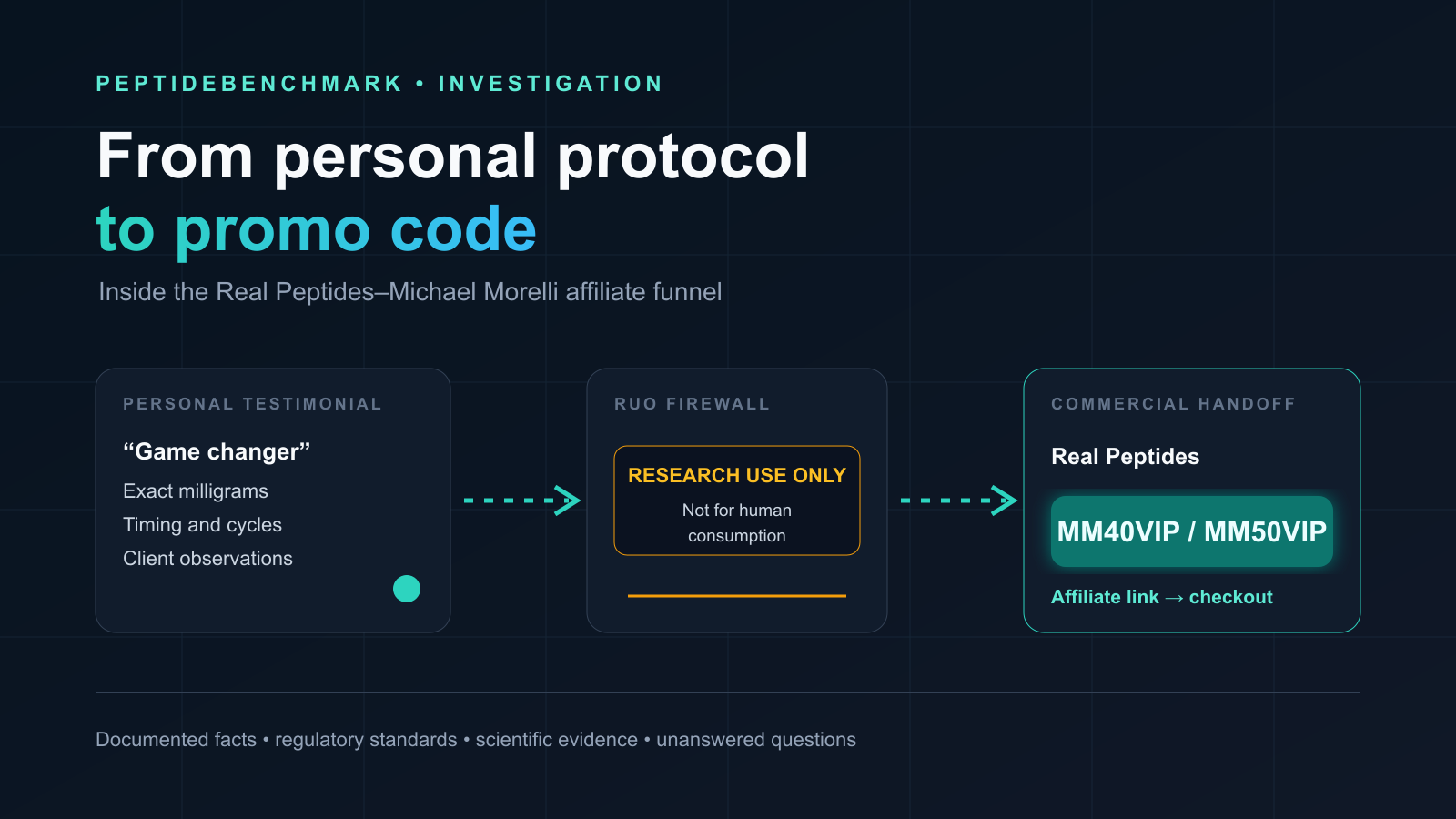
The public pitch follows a repeatable path.
First comes a first-person result: more endurance, dramatically less fatigue, deeper sleep, quieter “food noise,” sharper focus. Then comes a protocol—sometimes down to milligrams, timing, cycling, and route of administration. Scientific studies give the story authority. A research-use-only disclaimer appears somewhere along the way. Finally, the thread points to Real Peptides with a personalized code worth 40% or 50% off.
That pattern appears repeatedly in public posts by fitness entrepreneur Michael Morelli. In at least two of the threads reviewed for this article, Morelli expressly calls the sales link an affiliate link. Real Peptides, meanwhile, publicly advertises an affiliate program paying a standard 25% commission and offering store credit after five sales. We do not know Morelli’s private compensation terms, whether the company reviews his posts, or whether any particular thread was coordinated in advance.
What the public record does show is a sustained commercial relationship in which Morelli’s personal human-use stories lead readers to the same research-only vendor. Newly reviewed posts also show the promotion running in both directions: Real Peptides quote-posts Morelli’s testimonials, publishes its own consumer-directed peptide recommendations, and—according to the supplied public replies—has used Morelli’s MM40VIP code beneath brand posts.
That matters for two separate reasons:
- The FTC question: Is the financial relationship disclosed clearly and early enough, and are the health claims adequately substantiated?
- The FDA question: What does “not for human consumption” mean when an affiliate describes his own use, gives human protocols, says he has helped hundreds of clients, and then links directly to the seller?
Important: This article is not a legal determination and does not accuse Real Peptides or Michael Morelli of violating the law. FDA and FTC liability is fact-specific, and important contractual facts are not public. This is a documented analysis of public marketing against the agencies’ published standards. It is also not medical advice.
What is documented—and what is not
Here is the cleanest way to separate the evidence from the inference.
Documented in public posts and pages:
- Morelli has repeatedly described personally using MOTS-c, retatrutide, Semax, DSIP, Epithalon, Pinealon, and other compounds.
- His posts include exact human-use amounts, schedules, timing, combinations, claimed effects, and adverse-reaction observations.
- He has said that he has helped or worked with “hundreds of clients” and uses that experience to modify the protocols he discusses.
- He has linked readers to Real Peptides using referral path
ref/294and personalized codesMM40VIPandMM50VIP. - In at least two threads, he explicitly described the Real Peptides link as an affiliate link.
- Real Peptides publicly offers affiliates a standard 25% commission, a 30-day cookie, and a $400 product voucher after five referred sales.
- Real Peptides sells the same compounds featured in the posts and labels them for laboratory research only, not human consumption.
- Morelli has repeatedly amplified Real Peptides’ posts. Real Peptides has also quote-posted Morelli’s Selank testimonial, urged readers to try the product, and—according to the supplied public reply—directed them to its store with his
MM40VIPcode. - Real Peptides has told men over 30 that a multi-compound peptide stack is “non-negotiable,” said “life is better on retatrutide,” and written that tesamorelin “should almost always” be combined with ipamorelin.
- Morelli has paired detailed peptide-cycle content with promotion of a coaching business described as including biomarker testing, hormone and recovery optimization, and weekly one-on-one coaching.
Not established by the public record reviewed here:
- that Morelli owns, manages, or is employed by Real Peptides;
- that his private commission rate is the standard 25%;
- that Real Peptides wrote, approved, or paid separately for any specific post;
- that the two parties have a personal relationship beyond their documented promotional connection; or
- that either party has violated a particular statute.
Calling this a “close” relationship is therefore an inference about the frequency, commercial structure, and content alignment of the promotion—not a claim about undisclosed ownership or friendship.
The public timeline
- March 28: Morelli says peptides “heal at the root”, assigns BPC-157, TB-500, MOTS-c, CJC/ipamorelin, and GHK-Cu to specific goals, and follows with a pitch for his coaching system.
- April 3: Morelli describes his sixth retatrutide cycle and an 18-week system involving GLP and GH peptides, MOTS-c, AOD-9604, 5-Amino-1MQ, and tesofensine; a follow-up promotes his FitScript service.
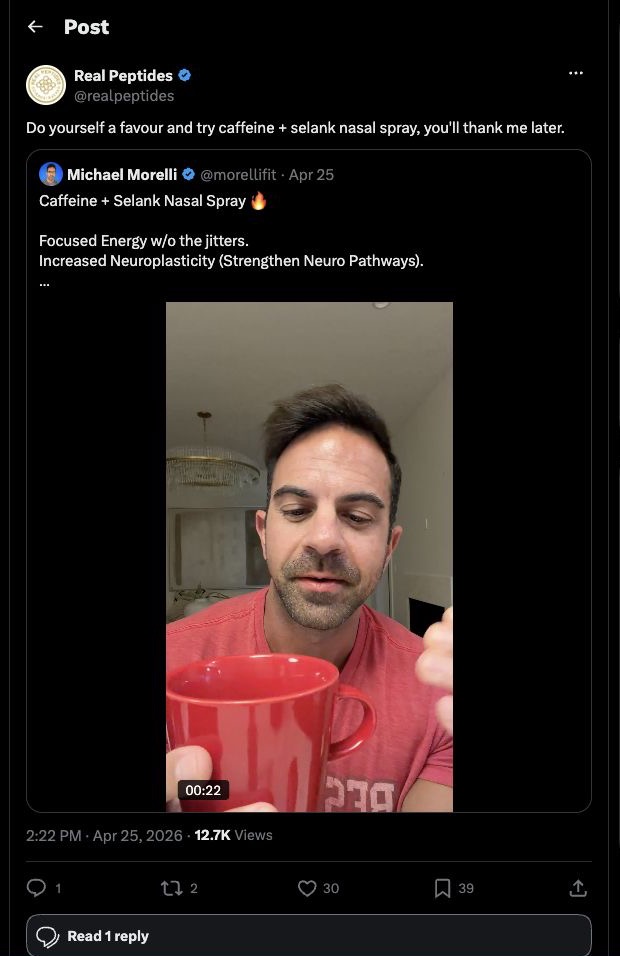
- April 25: Real Peptides quote-posts Morelli’s Selank nasal-spray testimonial and tells readers to try the caffeine-Selank combination. A supplied public reply promotes the product using
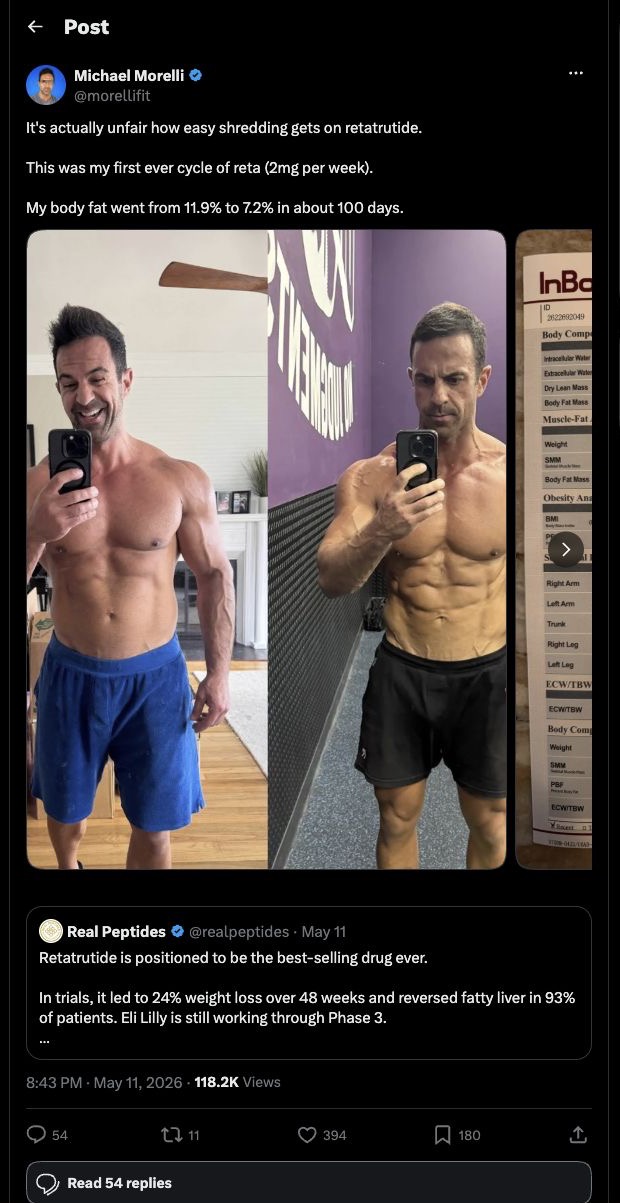
MM40VIP. - May 11: Morelli quote-posts a Real Peptides retatrutide thread, gives his dose, and attributes a body-fat change from 11.9% to 7.2% to his first cycle.
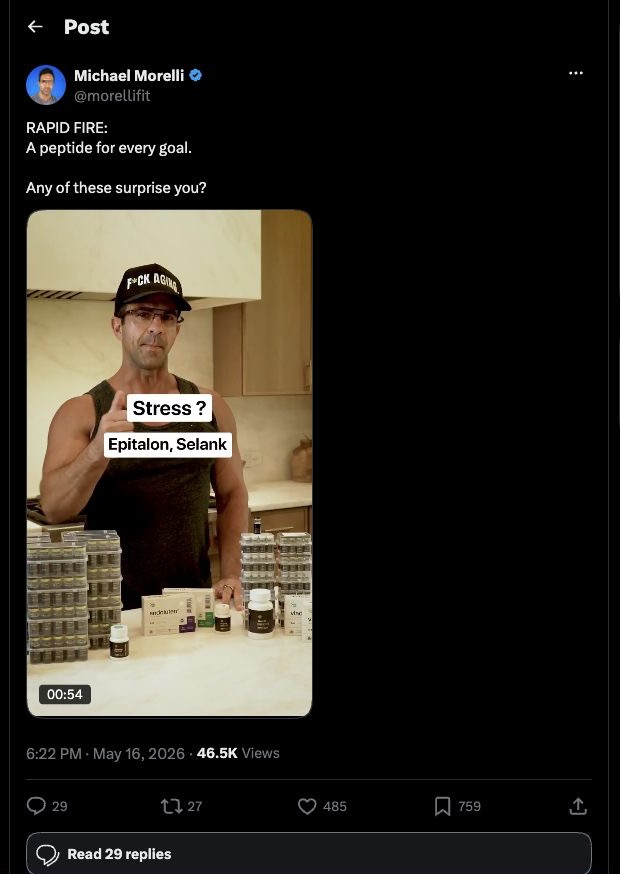
- May 16: Morelli publishes “A peptide for every goal” as a rapid-fire video, extending the same goal-oriented framing across multiple compounds.
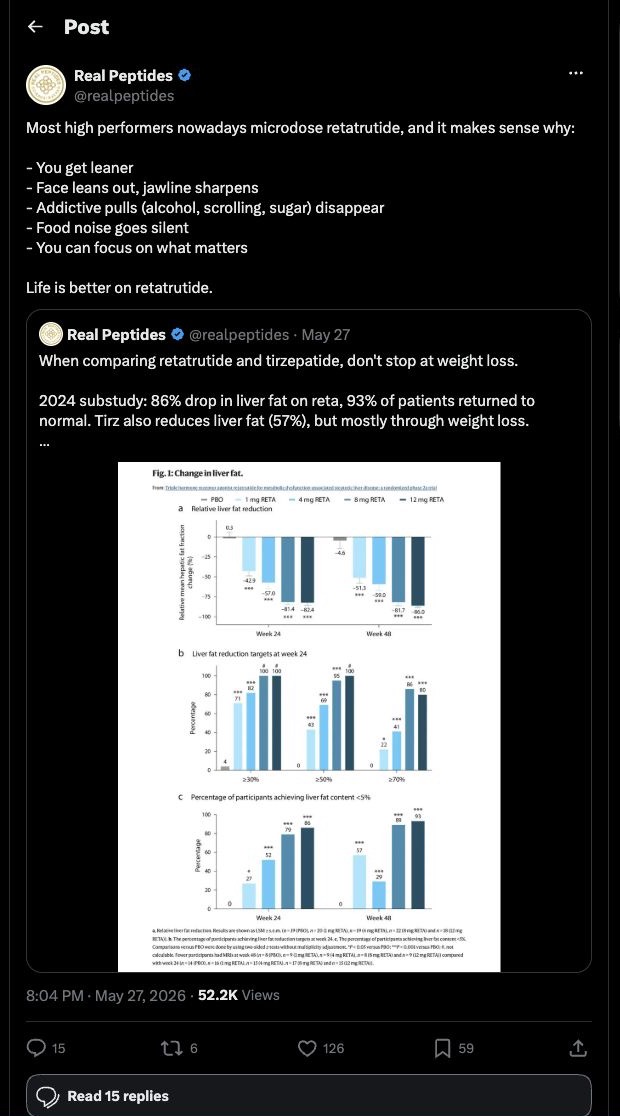
- May 27: Real Peptides says “life is better on retatrutide”. A supplied public reply directs readers to buy it with Morelli’s
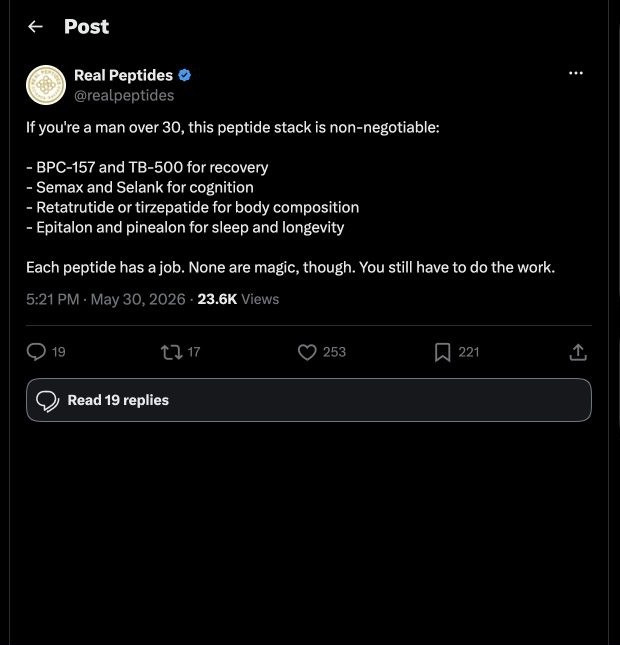
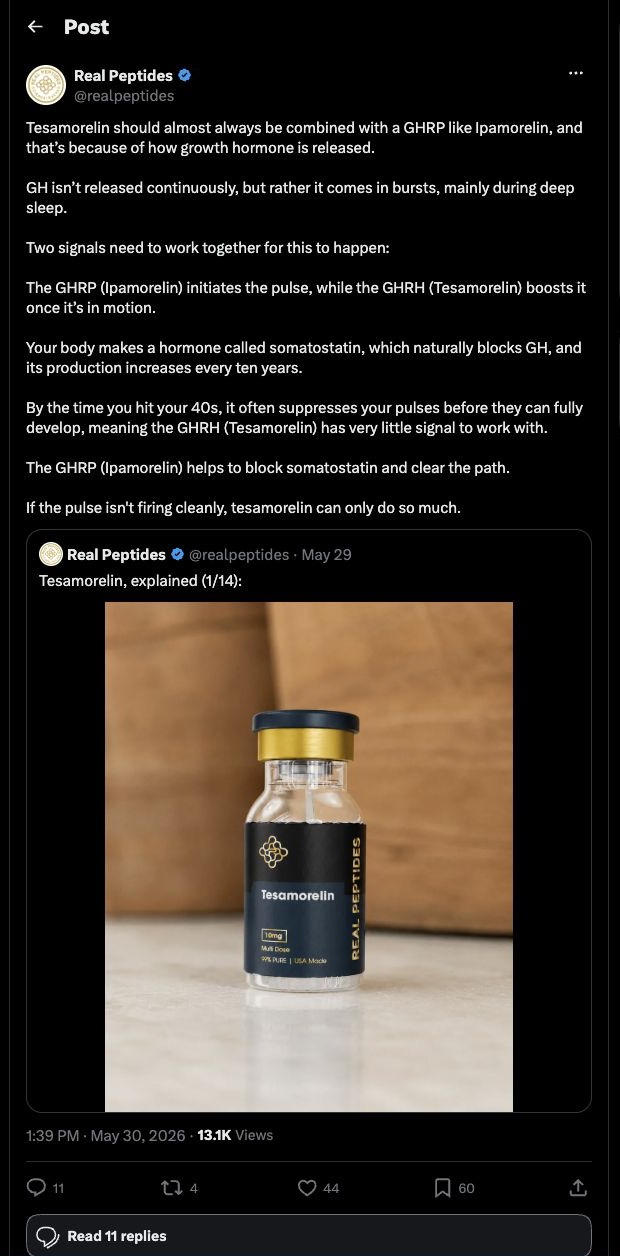
MM40VIPcode. - May 30: Real Peptides calls a four-category stack “non-negotiable” for men over 30 and separately says tesamorelin “should almost always” be paired with ipamorelin.
- June 10: Real Peptides promotes Semax and Selank as a cognitive stack and frames the choice as nasal versus injectable.
- June 25: Morelli calls Semax a “limitless pill”, describes frequent personal use, and later directs readers to Real Peptides with
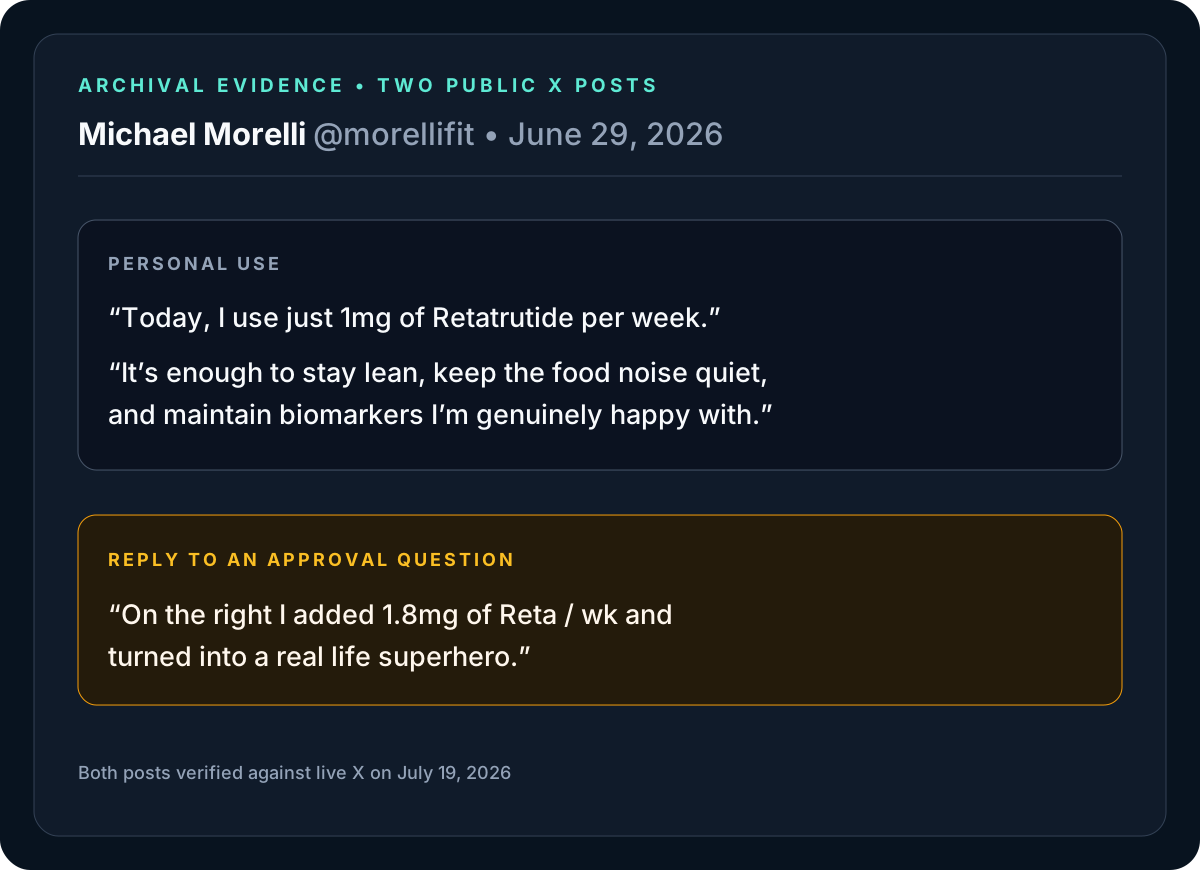
MM40VIP. - June 29: Morelli describes using 1 mg of retatrutide weekly and separately says 1.8 mg per week turned him into a “real life superhero”.
- July 2: Morelli publishes a 16-part MOTS-c protocol, refers to experience with hundreds of clients, and closes with a Real Peptides offer.
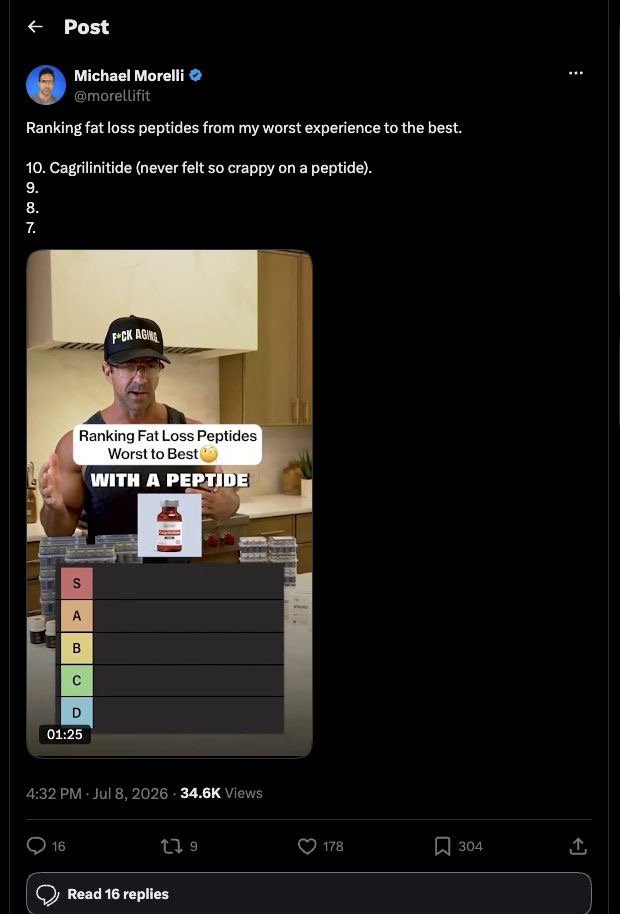
- July 8: Morelli ranks fat-loss peptides from his personal experience, placing peptide self-experimentation inside a broader stream of consumer-facing comparison content.
- July 9: Morelli publishes the three-peptide sleep stack, then directs readers to
realpeptides.co/ref/294/withMM50VIP. - July 18: Morelli quote-posts Real Peptides’ MOTS-c content, repeats his personal protocol, and follows with a Real Peptides affiliate offer using
MM40VIP.
The timeline does not prove that the company planned the posts. It does show recurrence across compounds, formats, and discount campaigns—not a single casual recommendation.
Exhibit 1: the MOTS-c testimonial, protocol, and affiliate handoff
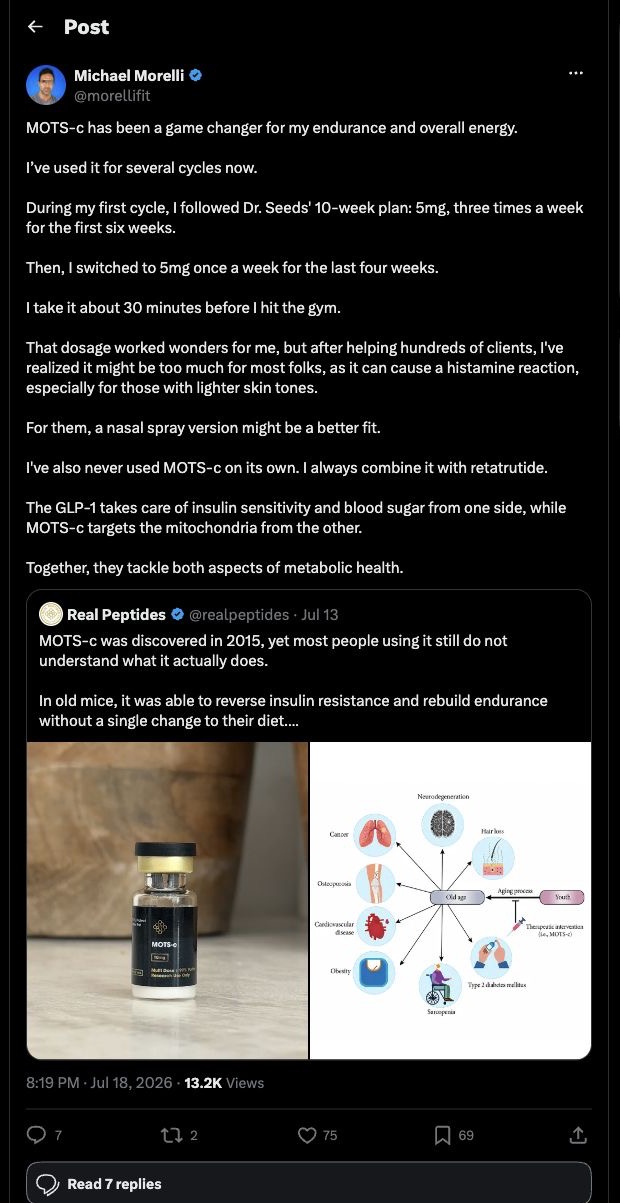
On July 18, Morelli quote-posted a Real Peptides thread about MOTS-c and wrote that the compound had been a “game changer” for his endurance and energy. He described multiple cycles, a ten-week schedule, 5 mg doses, workout timing, a claimed histamine reaction pattern, a nasal-spray alternative, and combining MOTS-c with retatrutide.
“I take it about 30 minutes before I hit the gym.”
“I always combine it with retatrutide.”
“Together, they tackle both aspects of metabolic health.”
In a follow-up supplied with the thread, he then wrote:
“This is where I get MOTS-c injectable so I’ll leave an affiliate link for you to check it out. Use code ‘MM40VIP’ to get 40% off.”
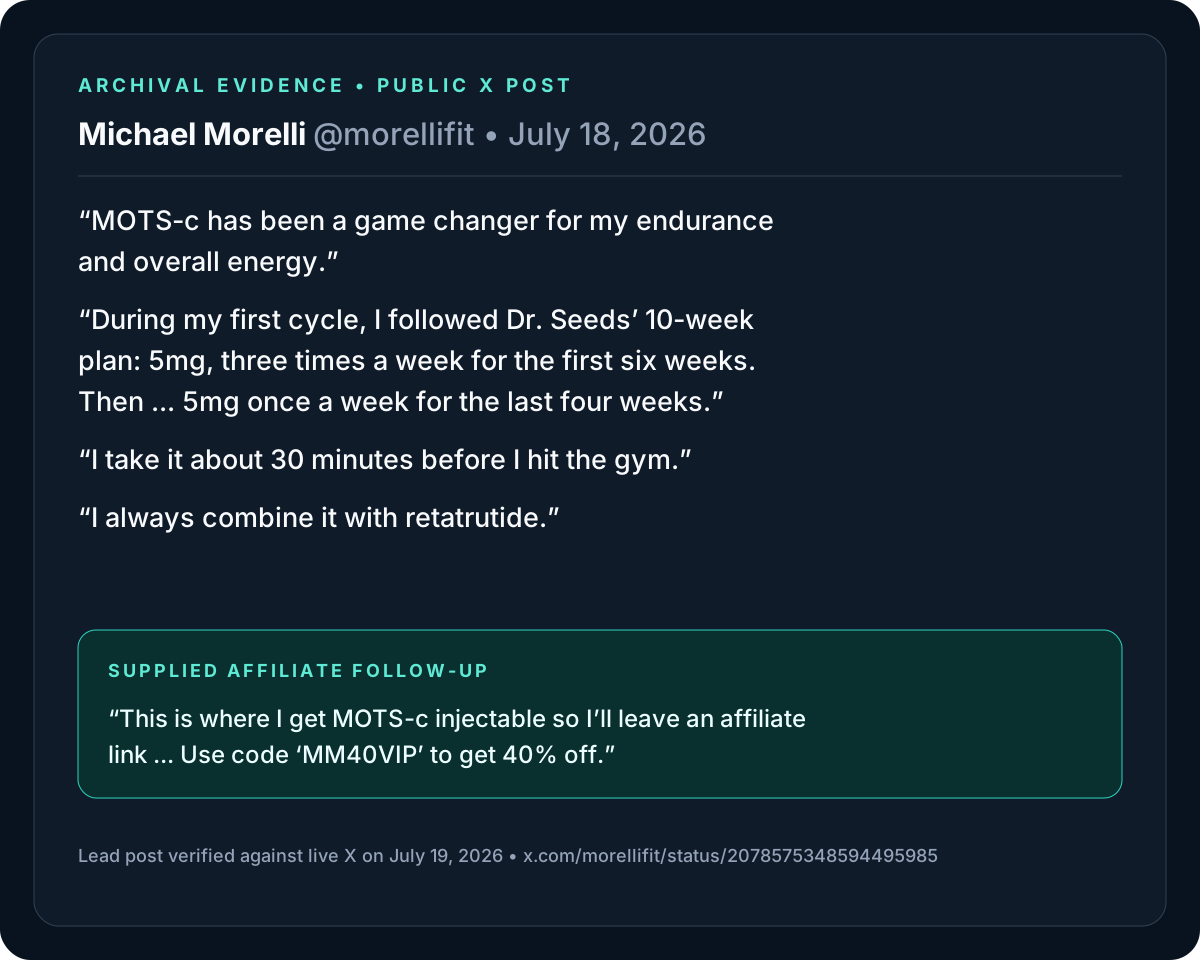
The sequence matters. A consumer first encounters a detailed human testimonial and protocol. The commercial relationship appears only after the recommendation, in a reply or later post. Morelli does use the words “affiliate link,” which is more transparent than merely dropping a code. The narrower question is whether that disclosure is clear and conspicuous in the context of the entire endorsement.
Exhibit 2: this was not a one-off
The July 18 language closely tracks an earlier 16-part MOTS-c thread from July 2. In that thread, Morelli said:
“I’ve run several MOTS-c cycles now, and the effect on my energy and recovery is impossible to ignore. My fatigue drops dramatically.”
He later supplied the same 5 mg schedule, said he administers it before workouts, and wrote that after working with “100s of clients” he had found the dose too high for many people. He then linked to Real Peptides, promoted both injectable and nasal-spray versions, and offered MM40VIP.
The thread did include a disclaimer:
“This is just my personal experience, not medical advice. Peptides are sold as research-use-only and not for human consumption, so talk to a qualified doctor before doing anything.”
But the rest of the thread described personal administration, a human protocol, reactions in clients, a route-of-administration alternative, and a product source.
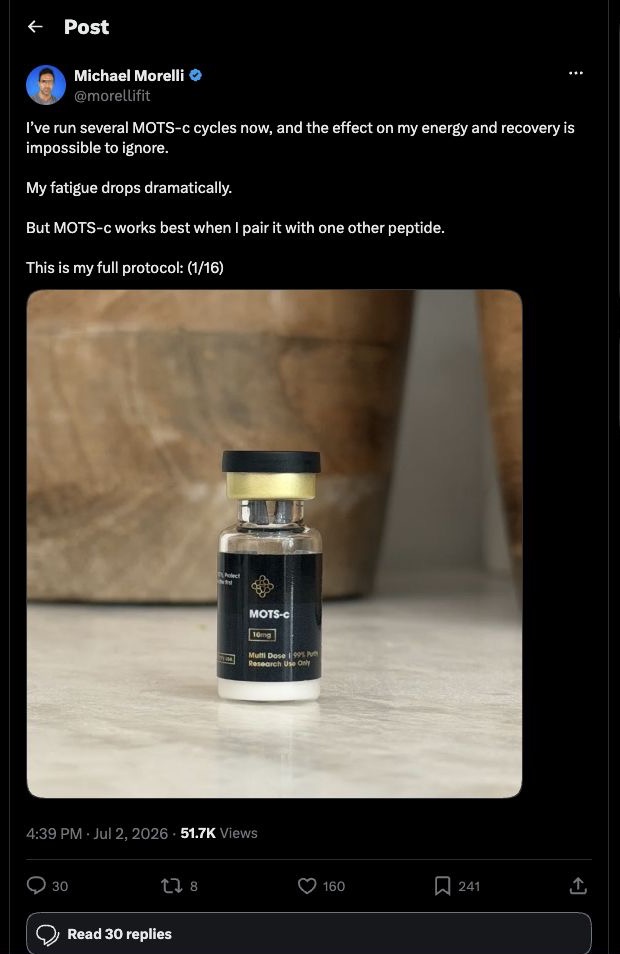
Exhibit 3: “nothing touched what these 3 peptides did”
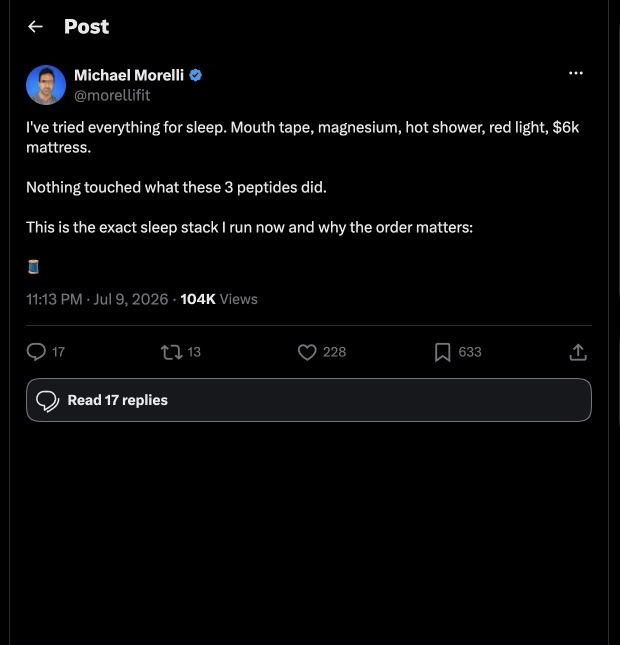
On July 9, Morelli opened a sleep thread with a vivid testimonial:
“I’ve tried everything for sleep. Mouth tape, magnesium, hot shower, red light, $6k mattress. Nothing touched what these 3 peptides did.”
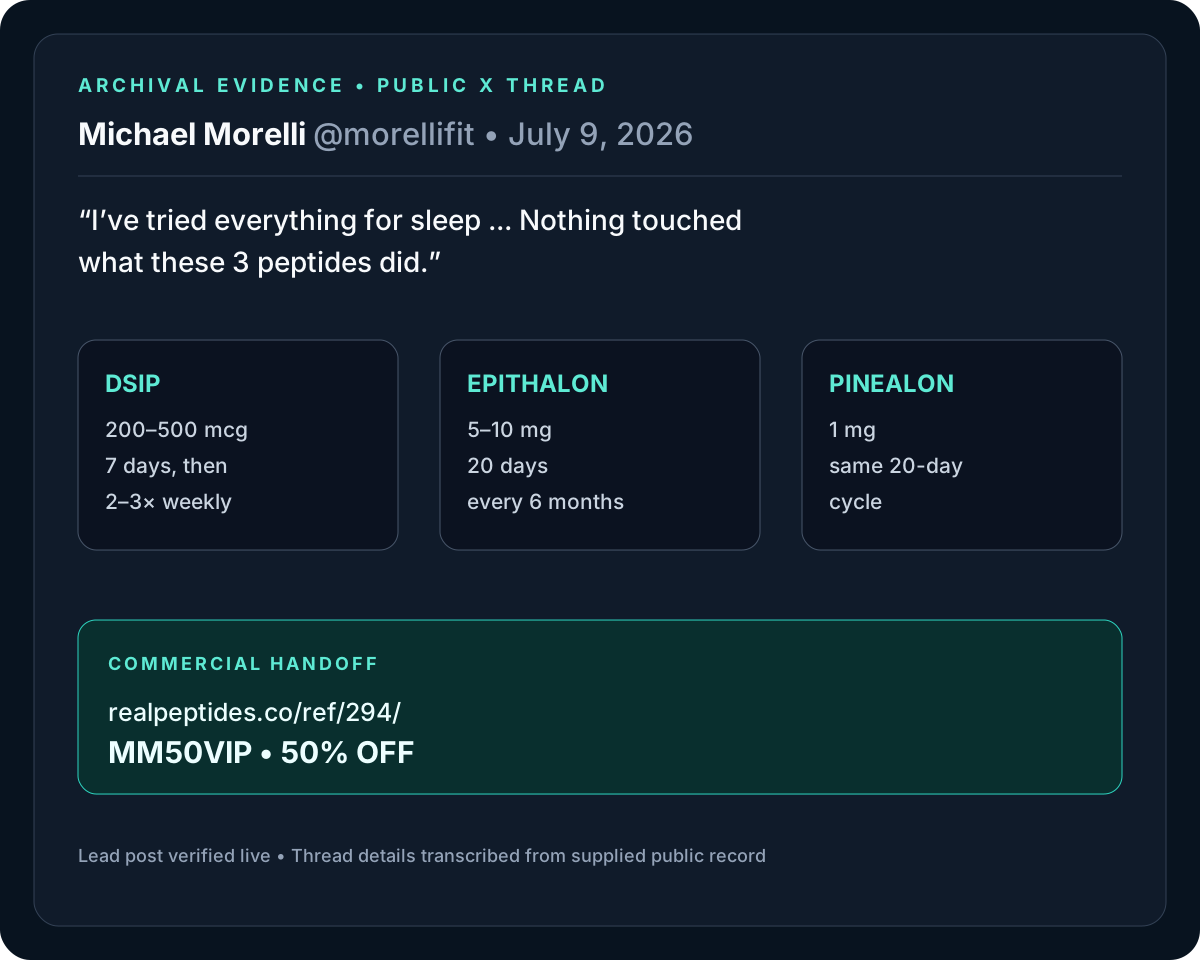
The thread described DSIP, Epithalon/Epithalamin, and Pinealon as a three-layer sleep stack. It supplied amounts and schedules:
- DSIP: 200–500 mcg, nightly for seven days, then two to three times weekly;
- Epithalon: 5–10 mg for 20 days every six months; and
- Pinealon: 1 mg on the same 20-day cycle.
The final sourcing section directed readers to Real Peptides through realpeptides.co/ref/294/ and offered MM50VIP for 50% off.
Morelli did acknowledge important limitations: he called the human DSIP evidence mixed, described Pinealon evidence as preclinical, and noted that the Epithalon mortality finding came from one research group and lacked independent replication. Those caveats are worth crediting. They do not change the net sales sequence: personal result, exact stack, scientific framing, vendor recommendation, affiliate discount.
Exhibit 4: Semax as a “limitless pill”
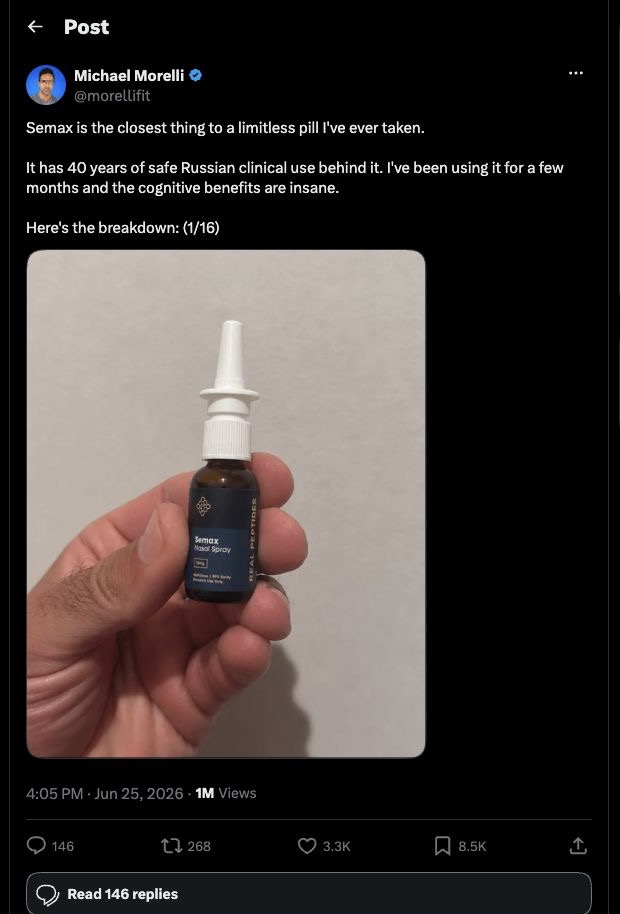
On June 25, Morelli opened another 16-part thread:
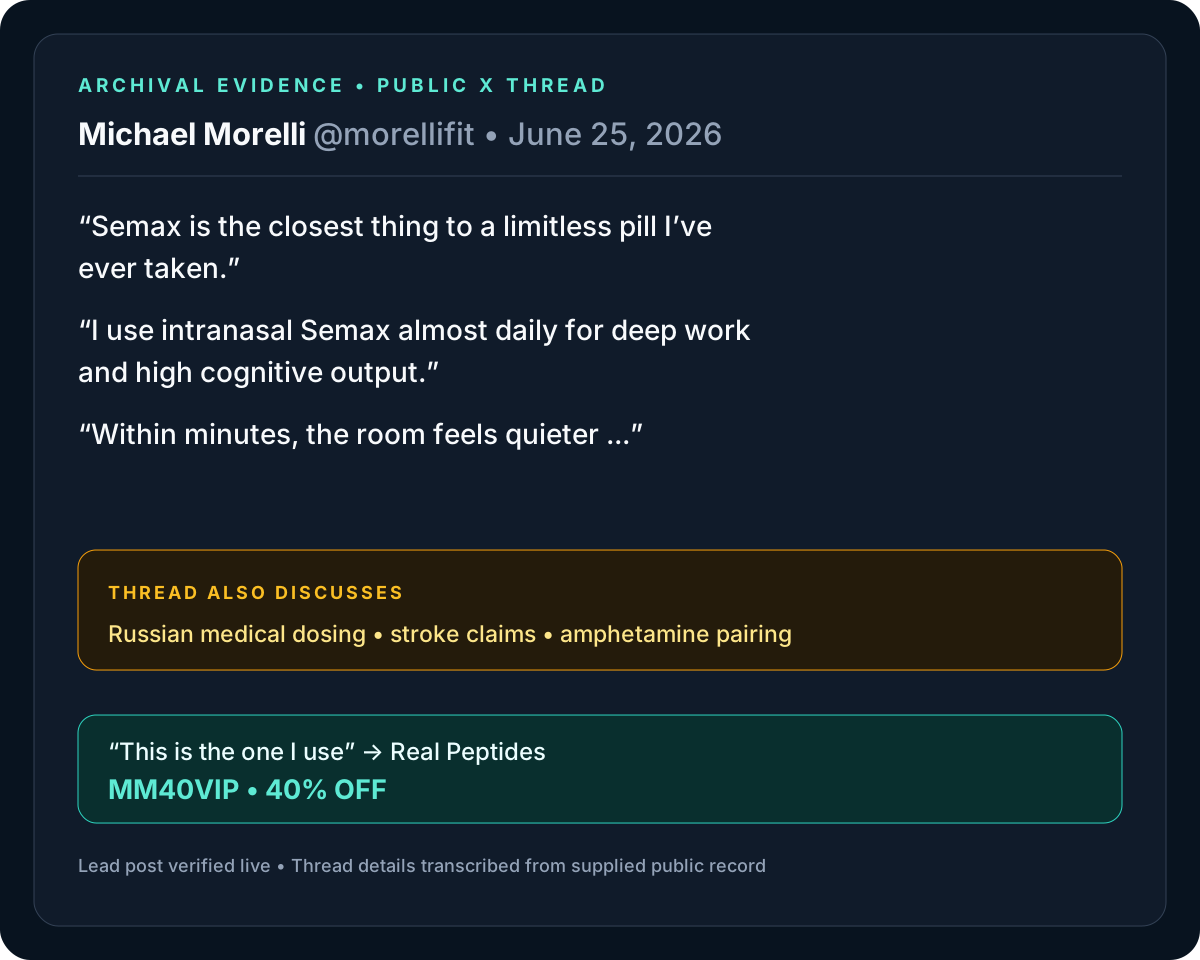
“Semax is the closest thing to a limitless pill I’ve ever taken.”
He described using intranasal Semax “almost daily,” claimed that the room felt quieter within minutes, discussed Russian medical dosing and stroke use, described pairing it with amphetamines, and said his own experience confirmed a clean-focus effect. Near the end, he linked to the version he uses at Real Peptides and offered MM40VIP.
The thread closed with “none of this is medical advice” and “always consult your doctor.”
Real Peptides itself had posted days earlier that Semax and Selank “might be the most complete cognitive stack you could ever run” and asked which route readers “should” take. Morelli reposted that thread, according to the public X context supplied for this review.
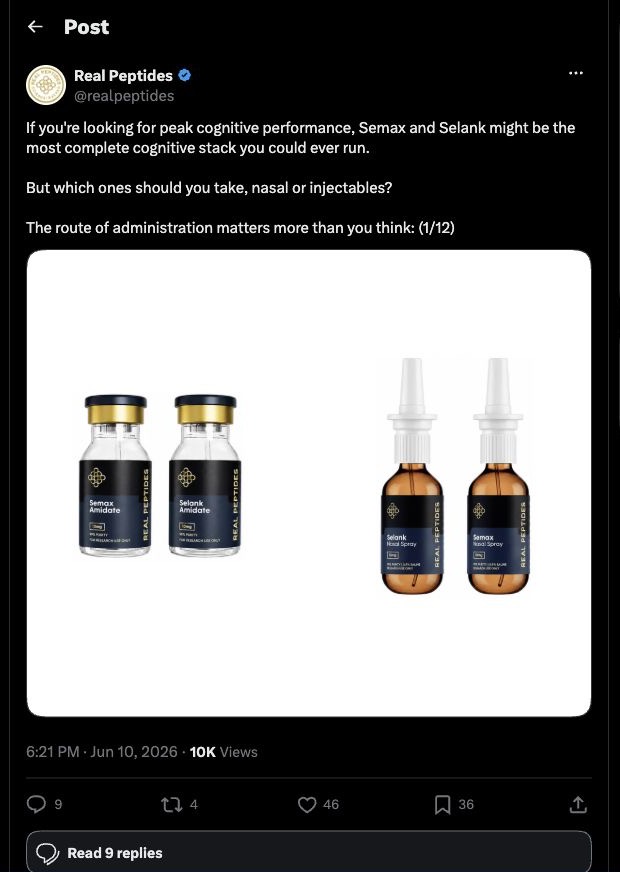
The brand’s storefront also publishes a page titled “Calculate Semax Amidate Dosage — Research Protocol Guide” with route-specific dose ranges and administration details—while describing the protocols as research use.
Exhibit 5: retatrutide, personal use, and the unapproved-drug context
Two June posts make the human-use context unusually direct.
On June 29, Morelli wrote that he uses 1 mg of retatrutide per week to stay lean, quiet food noise, and maintain biomarkers he likes. In a separate exchange responding to a doctor who noted that retatrutide was not approved, Morelli wrote:
“On the right I added 1.8mg of Reta / wk and turned into a real life superhero.”
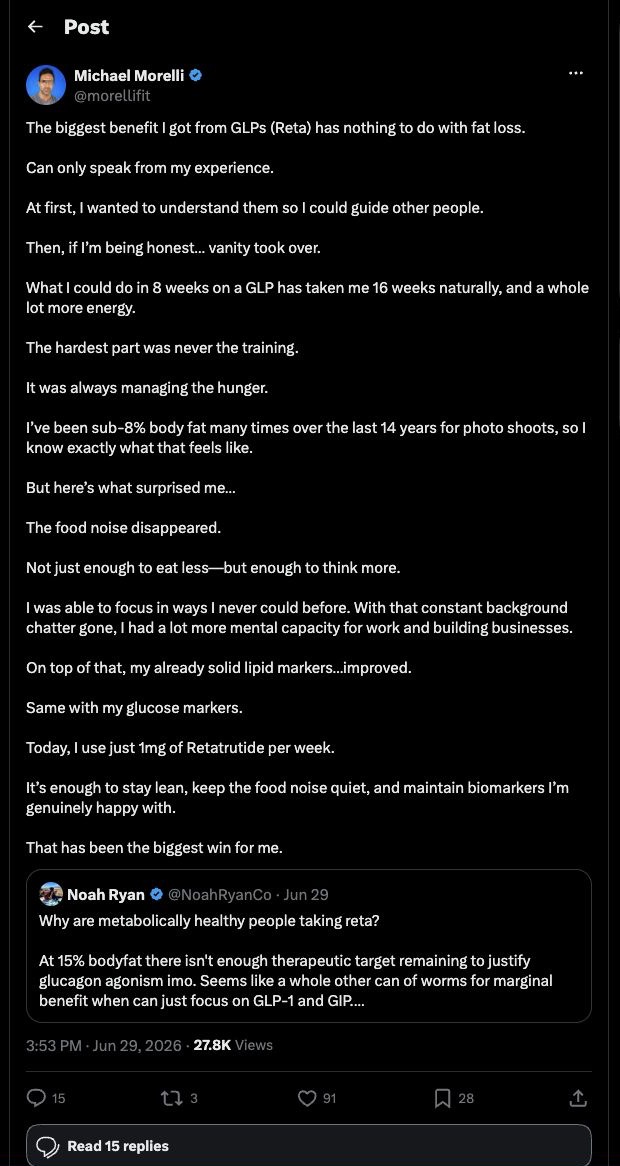
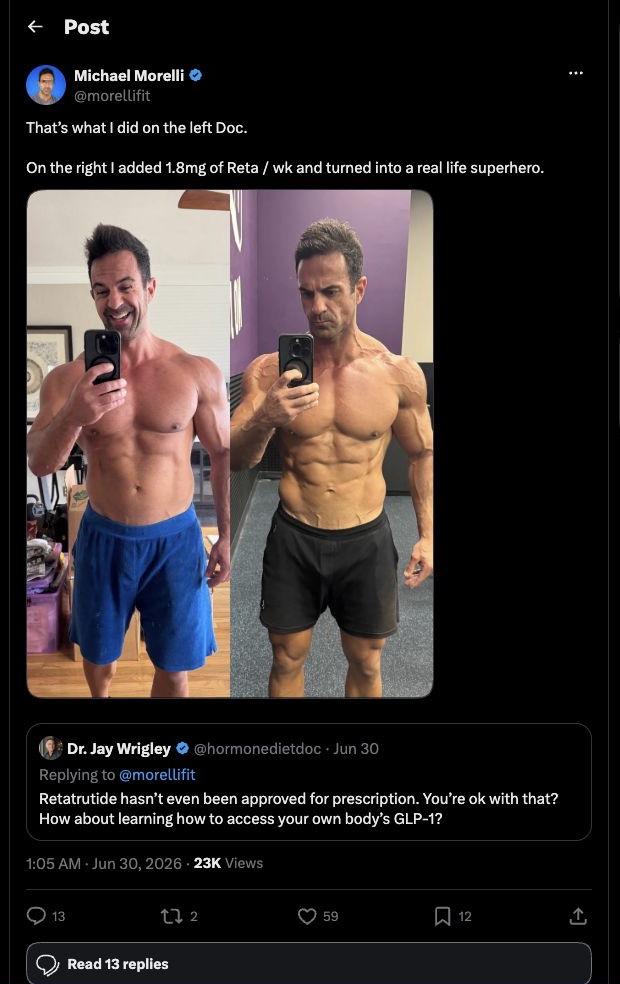
The retatrutide content also includes dramatic before-and-after and comparison framing. On May 11, Morelli attributed a body-fat change from 11.9% to 7.2% to his first retatrutide cycle. On May 16 and July 8, he published goal-oriented and ranked peptide comparison videos.
As of this article’s publication, Eli Lilly describes retatrutide as investigational, not FDA-approved, and unavailable for public use outside its clinical trials. The FDA likewise says retatrutide is not a component of an approved drug, cannot be used in compounding under federal law, and has been sold by some companies under false “research purposes” labeling.
Positive clinical-trial data do not make a gray-market vial equivalent to Lilly’s investigational product. The trial sponsor controls identity, manufacturing, dosing, monitoring, eligibility, and adverse-event reporting. A retail RUO product sits outside that system.
The relationship runs both directions
The earlier exhibits could be read as a familiar affiliate arrangement: an outside promoter discusses a product, then sends traffic to a merchant. The additional record is more integrated than that.
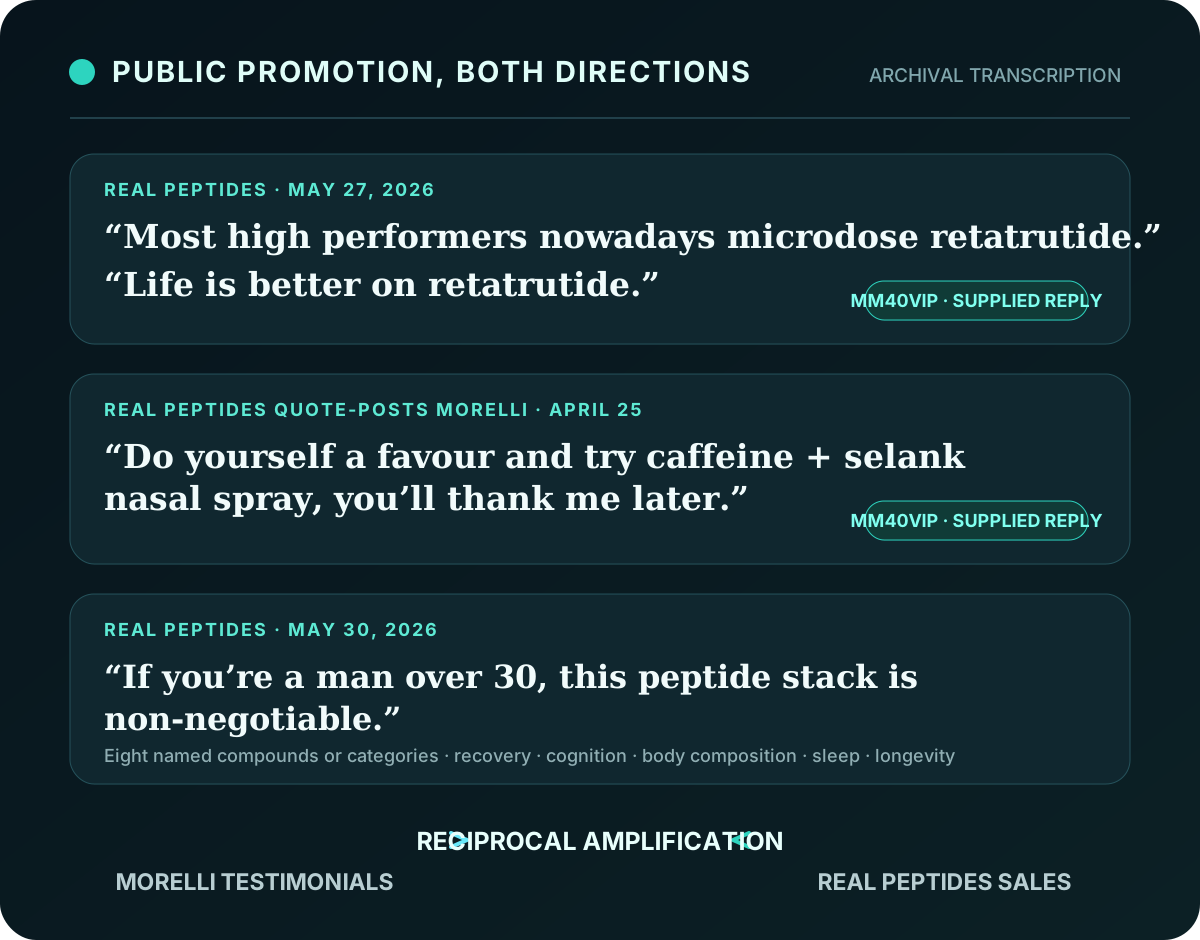
On April 25, Real Peptides quote-posted Morelli’s claims that a caffeine-plus-Selank nasal spray supplied focused energy, increased neuroplasticity and memory, and reduced caffeine-related anxiety. The company added:
“Do yourself a favour and try caffeine + selank nasal spray, you’ll thank me later.”
According to the public reply supplied for this review, the company then offered the product at 40% off with MM40VIP—Morelli’s personalized code. On May 27, Real Peptides made another direct consumer pitch:
“Most high performers nowadays microdose retatrutide.”
“Life is better on retatrutide.”
The supplied public follow-up again used MM40VIP to route readers to the company’s store.
The company’s May 30 posts go further than summarizing research. One calls a stack of eight named compounds or categories “non-negotiable” for men over 30. Another says tesamorelin “should almost always” be combined with ipamorelin and describes what happens “by the time you hit your 40s.” These are direct recommendations framed around age, cognition, body composition, recovery, sleep, and longevity.
This evidence supports three findings:
- The amplification is reciprocal. Morelli quote-posts Real Peptides; Real Peptides quote-posts Morelli.
- The personalized code appears in company-controlled promotion. On the supplied record, the vendor itself uses
MM40VIP, not merely an independent affiliate. - Human-use framing comes from the brand as well as the affiliate. The relevant language includes “microdose,” “try,” “should,” and “non-negotiable,” tied to consumer outcomes.
It still does not establish private coordination, editorial approval, ownership, or Morelli’s compensation terms. Reciprocal public promotion is evidence of a close commercial marketing relationship; it is not evidence of every fact that might exist behind it.
A second commercial handoff: protocols to coaching
Morelli’s monetization does not stop at vendor referrals. On April 3, he published what he called the exact process used for his sixth retatrutide cycle: GLP and growth-hormone peptides in weeks one through eight, MOTS-c later in the cycle, a taper, and an “off-GLP stack” involving AOD-9604, 5-Amino-1MQ, and tesofensine. The post tells readers not to quit “cold turkey” and says that, if done correctly, they should end every cycle leaner.
The supplied follow-up then promotes a service built around “60+ biomarker labs,” custom nutrition and training, “hormone optimization,” and weekly one-on-one coaching, with a call to direct-message FITSCRIPT. A March 28 post similarly says peptides “heal at the root,” assigns compounds to gut, joint, tissue, mitochondrial, hormonal, hair, and skin outcomes, and follows with another coaching solicitation.
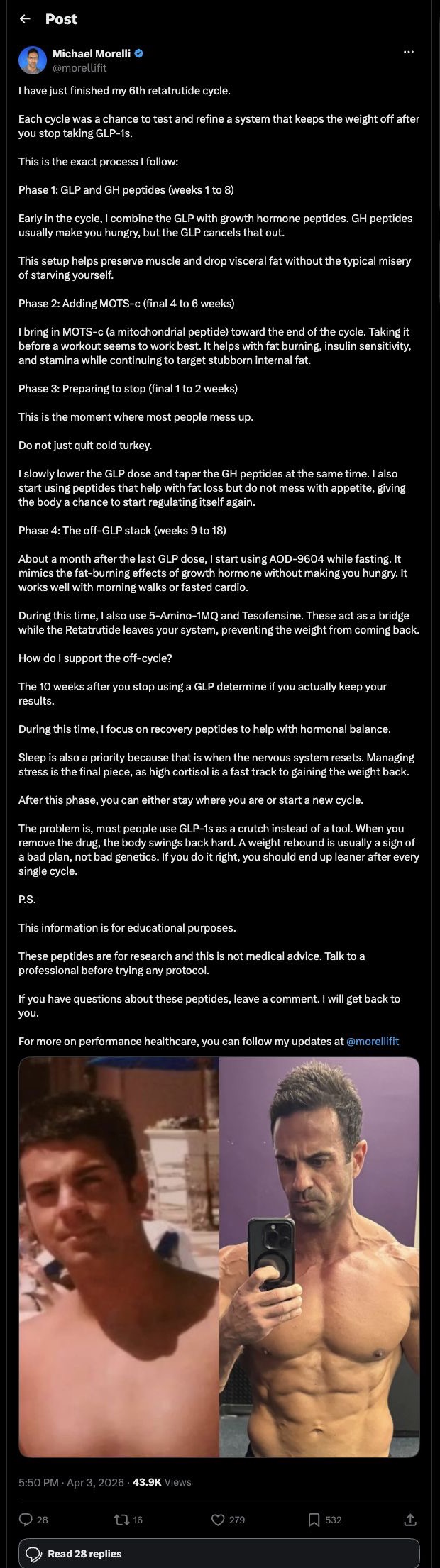
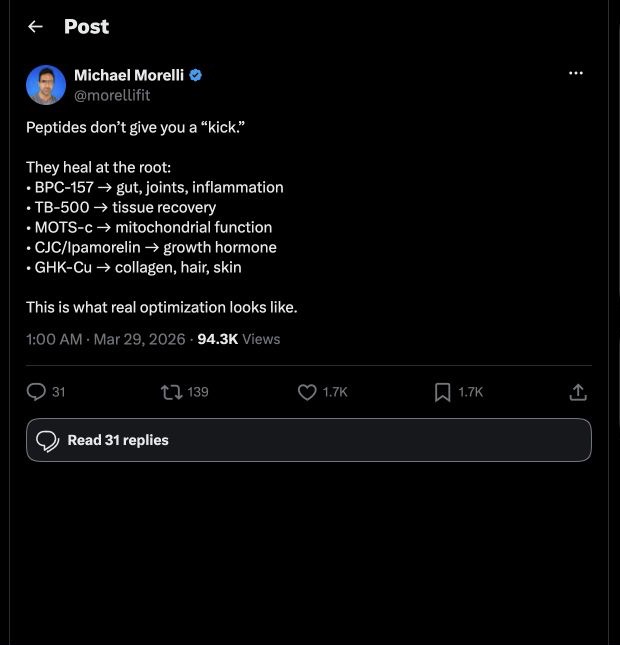
This does not establish that Real Peptides products are included in the coaching service or that Morelli practices medicine. It does establish that the same public account uses detailed RUO peptide protocols to build authority and acquire both product buyers and prospective coaching clients. That makes the statement that he has helped hundreds of clients more consequential—and raises a factual question about clinical oversight that the public posts do not answer.
The company’s own compliance explanation is unusually clear
Real Peptides’ website does not merely carry a generic footer. It has published detailed pages explaining the boundary in its own words.
Its MOTS-c legal guide says:
“Self-experimentation: Using the peptide on yourself to see if it helps you lose weight or build muscle is not research.”
Its Semax legal guide says that the same molecule becomes an unapproved drug problem when it is sold with dosing instructions or health claims. Its MOTS-c approval page says RUO means the compound has not been proved safe or effective for human use.
Those statements make the affiliate funnel more—not less—important to examine.
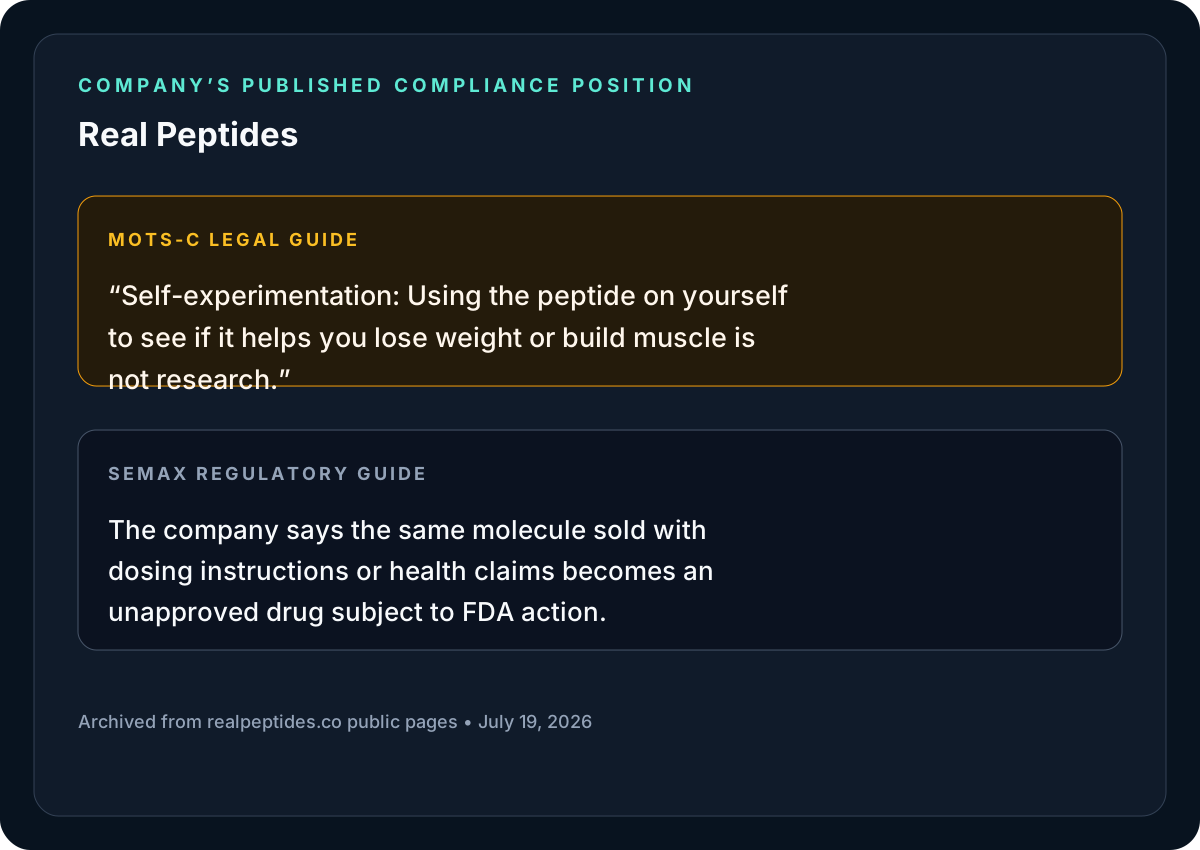
The site’s position is:
- self-experimentation is not research;
- human therapeutic use is outside the RUO lane;
- dosing instructions and health claims matter; and
- products are not for human consumption.
The affiliate promotion documents:
- self-experimentation;
- exact human amounts and schedules;
- reported physical and cognitive outcomes;
- observations drawn from clients;
- suggestions about injection versus nasal use; and
- direct links and codes to purchase the featured products.
That is the contradiction at the center of this article.
The affiliate relationship is material
Real Peptides’ public affiliate page says its standard program offers:
- 25% commission on every order;
- a $400 peptide voucher after five sales;
- a custom referral link;
- a 30-day attribution window; and
- marketing materials and promotional support.
Those are the company’s public standard terms. They do not prove Morelli receives the same rate or voucher, and the 40–50% customer discounts are not evidence of his commission percentage.
They do establish why the relationship matters to a reader evaluating a testimonial. A sale may financially benefit the person recommending the product.
What the FTC guidance says
The FTC’s Endorsement Guides Q&A says an affiliate should clearly and conspicuously disclose the relationship, close to the recommendation. It warns that:
- “affiliate link” by itself may not tell every consumer that the endorser is paid;
- a personalized discount code may show that some relationship exists but may not clearly reveal a financial one; and
- the same rules apply to endorsements and affiliate links in social posts.
Morelli’s express use of “affiliate link” is relevant and should not be omitted from a fair account. But the FTC evaluates the complete net impression, not whether two words appear somewhere in a thread. A disclosure placed after a long testimonial, below a “Show more” break, or in a reply may be less likely to travel with screenshots, reposts, or the lead post itself.
The FTC’s Health Products Compliance Guidance adds a second issue: testimonials do not substantiate health claims. The agency says animal and cell studies generally cannot establish human benefits without confirming human randomized trials, and an honest personal experience is not a substitute for evidence.
This is where the scientific storytelling matters. A reader can reasonably move from:
mice had improved metabolic outcomes
to:
Morelli experienced energy and recovery benefits
to:
this is the product he uses
to:
use his code to buy it.
The studies do not necessarily substantiate that final commercial impression.
What the FDA record says
FDA enforcement focuses on intended use—what the product is objectively being promoted for—not just the disclaimer printed beside it.
In a 2025 warning letter to USApeptide.com, the agency said “research use only” and “not for human consumption” statements did not overcome website evidence of human drug claims. In a 2024 warning letter to Prime Peptides, the FDA expressly reviewed both the vendor’s website and social-media marketing that directed consumers to buy products.
Those letters are not rulings about Real Peptides or Morelli. They show how the agency has analyzed similar facts.
Attribution is also important. Morelli’s statements do not automatically become Real Peptides’ statements merely because he uses an affiliate link. A regulator would look at facts such as payment, control, approval, monitoring, instructions, reposting, and the overall relationship. Those private facts are not available here.
But the regulatory analysis no longer depends only on attributing Morelli’s words to the company. Real Peptides’ own account publishes consumer directives and outcome claims, quote-posts Morelli’s testimonial, and—on the supplied public record—uses his personalized code. The FTC says advertisers should train and monitor paid influencers, and Real Peptides publicly says it supplies affiliates with marketing support.
The evidence gap, compound by compound
MOTS-c reversed insulin resistance and obesity and rebuilt endurance
The foundational 2015 study reported metabolic effects in mice. A 2021 paper found endogenous MOTS-c rises with exercise in people but tested exogenous performance effects in mice—not retail MOTS-c efficacy in humans.
Morelli’s MOTS-c protocol improved his fatigue, energy, and recovery
That is a testimonial. It cannot isolate MOTS-c from retatrutide, training, expectation, other compounds, or product-specific quality. FDA says it has not identified human exposure data for MOTS-c drug products by any route.
Semax has decades of safe clinical use and produces rapid cognitive effects
Published clinical literature exists, including a 110-patient post-stroke study, but that does not validate daily cognitive-enhancement use of a U.S. retail nasal spray. FDA says it has no or limited safety information for proposed Semax routes.
A DSIP/Epithalon/Pinealon stack restores deep sleep
The thread itself acknowledges mixed DSIP evidence and preclinical Pinealon evidence. Small or unreplicated studies do not establish the advertised three-compound stack, the supplied schedule, or typical results.
Retatrutide improves food noise and biomarkers at Morelli’s chosen dose
Retatrutide has clinical-trial evidence, but it remains investigational. Personal use of a gray-market product is not a controlled trial and does not establish identity, safety, or effectiveness.
The questions the public record cannot answer
A complete account would require answers from both parties:
For Michael Morelli
- What compensation, commission, free product, or other consideration does he receive from Real Peptides?
- Does Real Peptides review, approve, supply research for, or suggest topics for his posts?
- When he says he has helped hundreds of clients, what service is he describing, and are licensed clinicians involved?
- Are RUO peptide protocols, sourcing, or product recommendations part of the FitScript coaching service, and if so, what licensed clinical oversight applies?
- Does he believe a disclosure in a later reply is sufficiently visible to readers of the lead testimonial?
- How does he verify that the retail products he personally uses are the compounds and strengths represented?
For Real Peptides
- Is Morelli subject to the public 25% affiliate terms or a separate agreement?
- Does the company provide him products, content briefs, talking points, scientific references, or campaign timing?
- What rules govern affiliates’ personal-use testimonials and dosing discussions?
- Does the company monitor affiliate posts, and has it asked Morelli to change or remove any?
- How does it reconcile its statement that self-experimentation is not research with affiliate content that describes self-administration and directs readers to its store?
- Why has the company used
MM40VIPin its own public replies, and how does that code relate to Morelli’s compensation?
We have not represented that these questions were sent before publication. PeptideBenchmark will publish a substantive response from either party and correct any factual error supported by evidence.
Our conclusion
The most defensible conclusion is narrower than “secret partnership” and more significant than “just an affiliate link.”
The documented relationship is sustained, commercial, and publicly reciprocal. Morelli repeatedly converts first-person human-use experiences into Real Peptides referrals. Real Peptides quote-posts his testimonials, promotes some of the same human outcomes, and—on the supplied public record—uses his personalized code. The company sells the featured compounds and runs an affiliate system in which referrals can generate commissions and product credit.
At the same time, Real Peptides’ own compliance pages accurately describe self-experimentation as outside legitimate research and warn that dosing instructions and health claims can change the regulatory character of a sale.
The result is a two-layer message delivered by both sides of the funnel:
- formal layer: laboratory research only, never human consumption;
- promotional layer: here is what I took, how much I used, what it did for me and clients, which format may work better, and where to buy it with my code.
A disclaimer cannot make readers unsee the second layer. And an affiliate disclosure, even when present, does not answer whether the health claims are substantiated or whether the overall sales funnel communicates human intended use.
That is the real story: not that the commercial relationship was completely hidden, and not that reciprocal reposts prove a secret arrangement. It is that human-use promotion is hiding in plain sight behind a research-only label—and the vendor’s own posts now make that conclusion independent of whether every affiliate statement can legally be attributed to the company.
Complete source-screenshot archive
Every X post linked in the reporting record has now been preserved as a native page capture. Each image was captured from the public post-detail page on July 19, 2026 and cropped only to remove X’s navigation, signup prompt, and unrelated sidebar. No post content was reconstructed or edited. View and engagement counts are a point-in-time record and may differ from the live page.
View all 16 source screenshots
Methodology, source preservation, and disclosures
PeptideBenchmark reviewed the public X posts linked throughout this article, the thread text supplied for this investigation, Real Peptides’ public product, legal, and affiliate pages, FDA materials, FTC guidance, and primary research indexed by PubMed. All 16 linked lead posts were checked against live X and preserved as native captures on July 19, 2026. Because X may hide replies from logged-out readers and posts can be edited or removed, supplied thread replies that were not visible in the public browser capture remain clearly labeled as supplied transcriptions. The designed graphics are PeptideBenchmark archival transcriptions, not native X screenshots; the source archive above contains the native captures.
View counts are intentionally omitted from the analysis because they change and do not establish unique readership or persuasion. Quotations are excerpted for commentary and reporting. The article distinguishes company statements, affiliate statements, and PeptideBenchmark’s inferences.
PeptideBenchmark receives no commission from the Real Peptides or Morelli links in this article. We maintain disclosed affiliate relationships with other vendors, listed on our coupon and referral disclosure page. Those relationships do not affect the regulatory or evidence standards applied here.
Research chemicals discussed in this article are not approved for unsupervised human use. Do not use this reporting as dosing, sourcing, or medical guidance.