Barrier BPC-157 vs InfiniWell: Which Oral Delivery Technology Has Better Evidence?
Barrier BPC-GI and InfiniWell take very different approaches to oral BPC. We compare SNAC capsules, delayed release, LipoEmulsion spray, testing transparency, and the evidence missing from every format.
Disclosure first
PeptideBenchmark has a disclosed referral relationship with InfiniWell and may earn compensation from qualifying purchases. Barrier did not pay for this comparison and did not provide a product for it.
That relationship does not change the conclusion below. Affiliate status does not improve a product’s evidence grade, and neither company supplied PeptideBenchmark with product-specific human bioavailability data for this analysis.
This is an evidence and product-positioning comparison, not medical advice or a recommendation that BPC is appropriate for anyone.
The short answer
InfiniWell Rapid Pro has the most evidence-anchored delivery ingredient, but neither InfiniWell nor Barrier has publicly demonstrated superior BPC bioavailability in humans.
InfiniWell Rapid Pro contains salcaprozate sodium, better known as SNAC. SNAC is a real and studied oral peptide absorption enhancer used in approved oral semaglutide formulations. That gives Rapid Pro a stronger scientific starting point than a delivery system described only in proprietary marketing terms.
But there is an important limit: evidence that SNAC can help deliver semaglutide in a specific pharmaceutical tablet is not proof that an undisclosed amount of SNAC meaningfully increases absorption of BPC in an InfiniWell capsule.
Barrier occupies a different lane. Its BPC-GI tablet is positioned around releasing BPC throughout the GI tract to support the gut lining. That may be a rational design for local GI exposure, where systemic bioavailability may not even be the primary objective. The company, however, does not publicly show the dissolution testing needed to validate that full-tract release claim.
So there is no honest overall bioavailability winner yet.
What is actually being compared?
The phrase “Barrier BPC-157 vs InfiniWell” makes the products sound interchangeable. They are not.
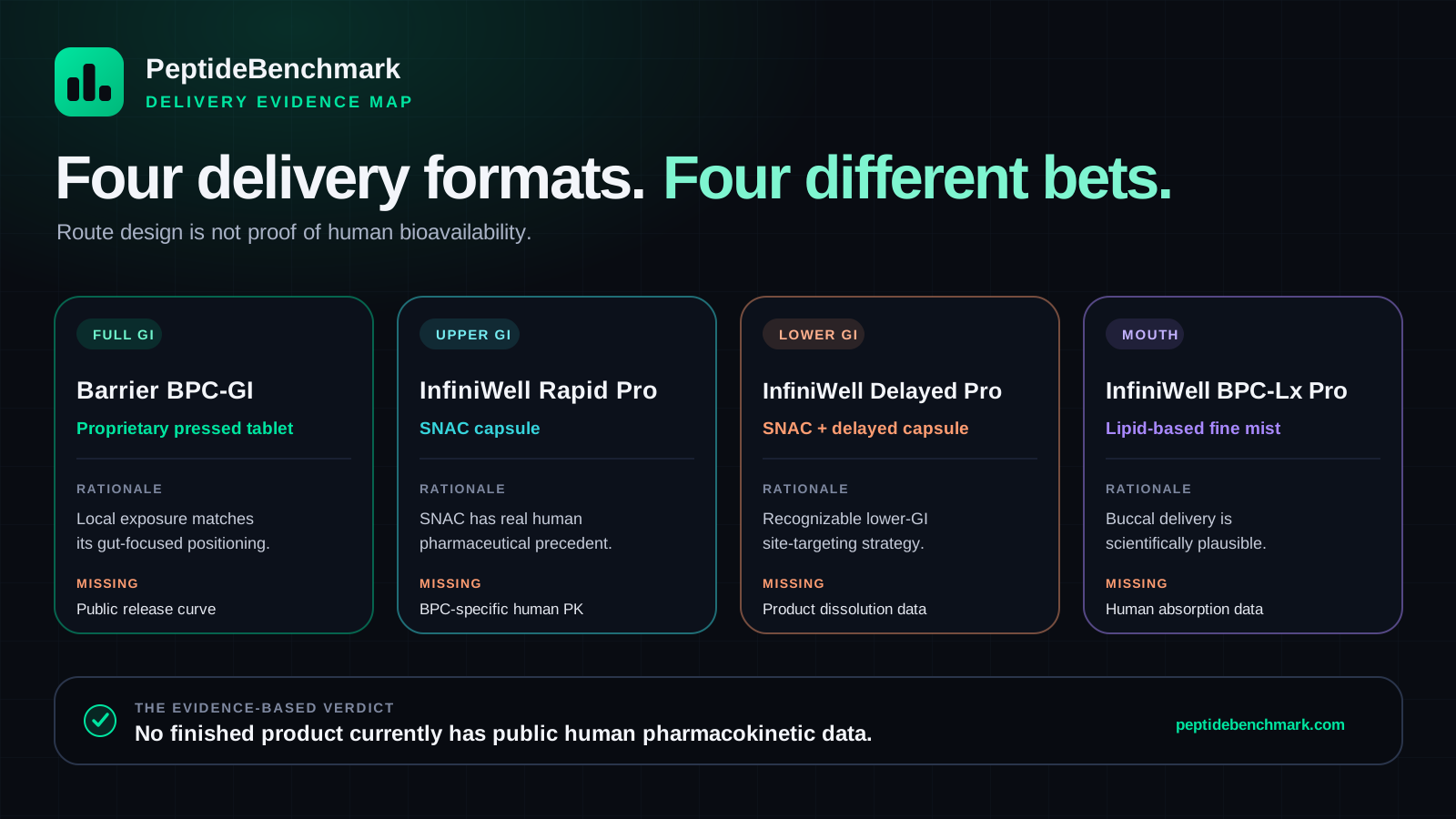
Barrier currently offers one main BPC-GI tablet. InfiniWell offers at least three materially different BPC formats:
- Barrier BPC-GI: a 500 mcg proprietary tablet intended to release across the GI tract
- InfiniWell BPC Rapid Pro: a 500 mcg capsule containing SNAC, positioned for upper-GI release
- InfiniWell BPC Delayed Pro: a 500 mcg delayed-release capsule containing SNAC and gellan gum, positioned for lower-intestinal release
- InfiniWell BPC-Lx Pro: an oral fine-mist spray using a proprietary LipoEmulsion delivery system
The labels also use terms such as BPC and Pentadeca Short Chain Amino Acids. Consumers should not assume that every product marketed in the BPC category has an identical formulation, manufacturing process, impurity profile, stability profile, or delivery behavior.
Barrier vs InfiniWell at a glance
Barrier BPC-GI
Technology: proprietary precision-pressed tablet
InfiniWell Rapid Pro
Technology: SNAC in a hypromellose capsule
InfiniWell Delayed Pro
Technology: SNAC plus a delayed capsule
InfiniWell BPC-Lx Pro
Technology: lipid-based oral fine mist
Why InfiniWell Rapid Pro has the strongest mechanistic case
The most scientifically recognizable ingredient across these products is SNAC in InfiniWell Rapid Pro and Delayed Pro.
SNAC is not just a branded phrase. It has been studied as an oral absorption enhancer for peptide drugs. In a primary semaglutide study, researchers found that the co-formulated semaglutide/SNAC tablet was absorbed through the stomach in an area close to the tablet surface. SNAC temporarily protected semaglutide from degradation and enhanced transcellular absorption.
That is meaningful evidence that the ingredient can work in the right formulation.
It is not a blank check for every peptide product. The same study described the mechanism as compound-specific, and the successful semaglutide system depends on close co-formulation, local concentration, tablet erosion, administration conditions, and a heavily characterized drug molecule.
InfiniWell publicly lists SNAC among Rapid Pro’s other ingredients, but it does not disclose:
- how much SNAC is in each capsule
- whether BPC and SNAC remain co-localized at the absorption site
- whether the capsule generates the local concentration needed for permeation
- whether intact BPC can be detected in human plasma after use
- absolute or relative bioavailability
This leads to the most precise conclusion I can support:
InfiniWell Rapid Pro has the strongest delivery-ingredient precedent, but the finished product’s BPC bioavailability remains unproven.
Why the same SNAC evidence transfers less cleanly to Delayed Pro
InfiniWell says its Delayed Pro capsule is designed to reach the lower intestines without succumbing to the upper digestive environment. Its ingredient panel lists SNAC and a capsule made with hypromellose and gellan gum.
That is a plausible site-targeting strategy. It does not automatically make Delayed Pro more bioavailable.
The strongest SNAC evidence comes from a formulation in which absorption occurred in the stomach, close to the tablet as it eroded. Moving release farther down the intestinal tract changes the pH, enzymes, transit conditions, mucus layer, surface area, and local concentration around the formulation.
Delayed Pro might make sense when lower-GI exposure is the intended goal. It has a weaker evidence bridge if the claim is greater systemic BPC absorption.
InfiniWell provides direct COA access from the Rapid and Delayed product pages, which is a positive transparency feature. But a COA showing identity or potency does not establish where a capsule releases or how much of its ingredient reaches circulation.
Barrier’s strongest argument is local GI exposure—not proven systemic absorption
Barrier says its 500 mcg BPC-GI tablet is precision-pressed to dissolve throughout the approximately 20-foot GI tract. The company positions it specifically around gut-barrier function and digestive comfort. In its own public posting, Barrier has described the same design more specifically as a pressed tablet that “erodes slowly as it transits,” exposing mucosa along the GI tract. That is a clearer company claim than the phrase precision-pressed alone. It is still a claim, not a public dissolution curve.
That framing matters because bioavailability is often used imprecisely.
If a product is intended to produce a local effect along the GI lining, a low blood concentration would not necessarily mean the delivery design failed. The more relevant questions could be:
- Does the tablet release at the claimed locations?
- How much intact peptide remains available at each location?
- How long does the gut lining remain exposed?
- Does the formulation change a validated local biomarker or clinical outcome?
Barrier currently provides none of those measurements publicly.
The company does not identify the excipients or physical mechanism that allegedly distributes release across the full GI tract. I also could not find a public dissolution profile showing tablet behavior in simulated gastric and intestinal conditions.
To validate the central delivery claim, Barrier could publish something as basic and useful as a multi-stage dissolution study showing percent release over time at changing pH levels. A scintigraphy or human transit study would be considerably stronger.
Without that evidence, precision-pressed and full GI tract release remain company claims rather than independently assessable performance characteristics.
Does InfiniWell BPC-Lx really bypass digestion?
InfiniWell’s BPC-Lx Pro is the most distinctive format in this comparison. It is a fine oral mist meant to be sprayed under the tongue or toward the inner cheek. InfiniWell says its LipoEmulsion delivery system supports rapid absorption and avoids breakdown in the stomach.
The concept is plausible. Buccal and sublingual delivery can avoid some gastrointestinal degradation and first-pass pathways. Lipid-based carriers can also improve the delivery of certain compounds.
But peptides remain difficult to deliver across oral mucosa. Molecular size, enzymatic degradation, saliva, short contact time, and the mucosal barrier can all limit uptake. Calling a format buccal or lipid-based does not demonstrate that an intact peptide reaches circulation in a meaningful amount.
For LipoEmulsion to become a validated BPC delivery technology rather than a proprietary formulation claim, I would want to see:
- particle or droplet-size distribution
- encapsulation efficiency
- intact-peptide stability over the stated shelf life
- ex vivo buccal-permeability testing
- comparison with an ordinary BPC solution
- human plasma concentration-time data
- absolute or relative bioavailability
InfiniWell says it has aggregated population-health data from more than 3,000 members. That may be interesting consumer-outcome information, but it is not a pharmacokinetic study and cannot establish absorption. At the time of this review, I could not access a complete protocol, dataset, statistical analysis plan, or study report from the product page.
My conclusion on BPC-Lx is therefore more cautious than my earlier convenience-focused editorial review:
BPC-Lx may be the easiest format to use, but convenience and bioavailability are separate questions. The public evidence currently supports the first much better than the second.
You can read my separate InfiniWell BPC-Lx Pro editorial review for more about the user experience and product positioning.
Testing transparency: InfiniWell has the public-access advantage
Both companies make extensive testing claims.
Barrier says every BPC-GI lot is tested for identity, potency, endotoxin, microbial limits, and heavy metals. Its product page says COAs are available on request.
InfiniWell places public COA links directly on its Rapid and Delayed product pages. The BPC-Lx page says every batch is tested by MS Bioanalytical for identity, potency, purity, heavy metals, microbial contaminants, and GMOs.
Public access is better than request-only access because readers can inspect documentation without contacting the company. That gives InfiniWell the stronger transparency presentation in this comparison.
Update — August 5, 2026
I re-checked Barrier’s public storefront and marketing after this comparison first published. As of this date:
- The live BPC-GI product page still says Certificates of Analysis are available on request. I still could not find a public permanent COA URL for the current lot.
- A Barrier marketing email claimed the company “tests every batch for purity and publishes the result.” That is stronger language than request-only access, but the storefront still did not expose a public COA portal or lot-specific link I could inspect without contacting the company.
- On Barrier’s public X account, multiple replies from March through June 2026 asked specifically for third-party testing data or COAs. In the threads I reviewed, those testing requests remained unanswered in public. That does not prove Barrier has no certificates. It does show that public requests for inspectable documentation have not produced a posted COA.
- The same marketing email mentioned a second SKU, BPC-IR, for “whole-body support.” As of this update, I still do not see BPC-IR on Barrier’s public storefront, so it is not part of this comparison until it has a product page, labeled claims, and testing documentation readers can inspect.
Neither approach answers the bioavailability question. Quality-control testing can help establish what is in a finished product. It ordinarily does not show:
- where the dosage form releases
- whether the peptide survives the delivery route
- whether it crosses a biological membrane
- what blood or tissue concentration it produces
- whether the claimed delivery system outperforms a conventional capsule
Third-party tested and more bioavailable are separate claims requiring different evidence.
What the human BPC evidence actually shows
The broader human BPC evidence base does not resolve this product comparison.
A Phase I study was registered to test the safety and pharmacokinetics of oral BPC-157 tablets in 42 healthy volunteers. It used a different product called PCO-02, with 1 mg BPC-157 tablets—not Barrier or InfiniWell’s finished products.
The trial record now shows an unknown status. Results were submitted in 2016 but never posted, and the submission cycle is marked as canceled. That means the registered study cannot currently be used as public evidence for oral BPC bioavailability.
The principal published BPC-157 pharmacokinetic paper studied intravenous and intramuscular administration in rats and dogs. It reported rapid metabolism and a prototype half-life under 30 minutes, but it did not test an oral tablet, delayed-release capsule, or buccal spray. It therefore cannot validate any product in this comparison.
This is the central evidence gap: we have product marketing, quality-control documentation, general delivery-science precedent, and substantial preclinical interest—but no public head-to-head human absorption data for these finished products.
Are Barrier and InfiniWell simply “legal BPC-157” companies?
I would not use that description without qualification.
Both are consumer-facing supplement companies rather than research-vial vendors. That changes the sales format and intended-use presentation, but market availability is not the same as FDA approval or a final legal determination about every aspect of a product.
Dietary supplements are not pre-approved by FDA for effectiveness. Facility registration, cGMP language, a Supplement Facts panel, or the standard DSHEA disclaimer does not mean FDA validated the ingredient, delivery system, safety, or claims.
FDA currently lists BPC-157 among compounding substances for which it has identified potential immunogenicity, peptide-impurity, and API-characterization concerns, while noting that it has limited safety information for proposed routes of administration.
FDA has also proposed that BPC-157 free base and BPC-157 acetate not be added to the 503A Bulks List at its July 23, 2026 Pharmacy Compounding Advisory Committee meeting. As of this publication date, that is a proposal rather than a final determination, and it concerns pharmacy compounding—not a direct ruling on these dietary-supplement products.
The careful description is therefore:
Barrier and InfiniWell sell consumer-facing BPC supplements, but their products are not FDA-approved BPC-157 drugs and should not be described as though approval or legal status has been affirmatively settled by their availability.
Which product has the better case?
The answer depends on what kind of evidence you mean.
Best delivery-ingredient precedent: InfiniWell Rapid Pro
Rapid Pro wins this narrow category because SNAC has genuine primary research and pharmaceutical precedent for oral peptide delivery. It still lacks product-specific human BPC data.
Most coherent gut-specific positioning: Barrier BPC-GI
Barrier makes the clearest case that its objective is exposure along the gut lining rather than simply maximizing systemic absorption. That is a coherent design goal, but the claimed release pattern needs public dissolution validation.
Most plausible lower-GI targeting: InfiniWell Delayed Pro
The delayed capsule has a recognizable site-targeting rationale. Its use of SNAC is less directly supported by the gastric semaglutide evidence, and InfiniWell has not published a product release curve or BPC PK study.
Most convenient but least characterized delivery claim: BPC-Lx Pro
BPC-Lx is portable, needle-free, and easy to use. The public record does not currently establish that LipoEmulsion delivers more intact BPC than either company’s swallowed products.
Questions I would like both companies to answer
Before treating any format as a demonstrated bioavailability leader, I would ask for the following.
For Barrier
- What ingredients or manufacturing process control the tablet’s release?
- Has BPC-GI undergone USP-style dissolution testing across changing GI pH conditions?
- Can Barrier publish a percent-release-over-time curve?
- Is the COA for the current lot available through a public permanent URL—not only on request, by DM, or behind a sales conversation?
- Has the finished tablet been tested for peptide stability through its full shelf life?
- If BPC-IR is a real upcoming SKU, when will it have a public product page and lot-level testing documentation?
For InfiniWell
- How much SNAC is present in Rapid Pro and Delayed Pro?
- Has either finished capsule undergone comparative dissolution or permeability testing?
- What evidence supports using SNAC in a delayed lower-intestinal formulation?
- What are BPC-Lx’s droplet size, encapsulation efficiency, and stability measurements?
- Has intact BPC been measured in human plasma after any InfiniWell product?
- Will InfiniWell publish the full protocol and report behind its 3,000-member claim?
Straight answers would materially improve this comparison.
Bottom line
InfiniWell Rapid Pro currently has the strongest scientific rationale for enhanced oral absorption because SNAC is a legitimate, studied peptide-delivery excipient. That advantage is mechanistic rather than product-specific. InfiniWell has not shown publicly how much intact BPC reaches circulation from Rapid Pro.
Barrier BPC-GI may be the more logically positioned product for localized GI exposure, but the company has not published dissolution testing supporting its claimed full-tract release. InfiniWell Delayed Pro similarly offers a plausible lower-GI strategy without validating its actual release or absorption profile.
BPC-Lx Pro may be the most convenient format, but its LipoEmulsion and bypasses digestion positioning currently have the largest gap between the strength of the delivery claim and publicly available product-specific evidence.
The honest winner is conditional:
- InfiniWell Rapid Pro wins on delivery-ingredient precedent.
- Barrier may win on gut-specific positioning.
- InfiniWell wins on public COA accessibility.
- No product wins on demonstrated human BPC bioavailability.
That last category is the one that would settle the debate, and right now it remains empty.
Sources
- Barrier BPC-GI product page
- Barrier public post describing slow-eroding GI transit delivery
- Public reply thread requesting Barrier third-party testing / COAs
- InfiniWell BPC Rapid Pro product page
- InfiniWell BPC Delayed Pro product page
- InfiniWell BPC-Lx Pro product page
- Buckley et al.: gastric absorption of semaglutide co-formulated with SNAC
- Bækdal et al.: oral semaglutide tablet erosion and pharmacokinetics
- ClinicalTrials.gov: PCO-02 oral BPC-157 safety and pharmacokinetics trial
- He et al.: preclinical BPC-157 pharmacokinetics in rats and dogs
- FDA: BPC-157 and other bulk substances that may present safety risks
- FDA briefing document for the July 23–24, 2026 PCAC meeting
- FDA guidance on dietary-supplement structure/function claims
Referral link and coupon code
If you choose to explore InfiniWell after reviewing the evidence and limitations above, PeptideBenchmark’s disclosed referral link is:
Visit InfiniWell through the disclosed referral link
Current PeptideBenchmark coupon code:
IW15— 15% off
The referral relationship does not affect the comparison, and the link should not be interpreted as medical guidance or a claim that the product is suitable for any individual.